Food truck website and schedule: where you are today, your menu, pre-orders and events
A food truck website has one job before anything else: answer “where are you today?”. That means a location schedule you update from your phone, today’s menu, pickup pre-orders and a simple way to book you for events.
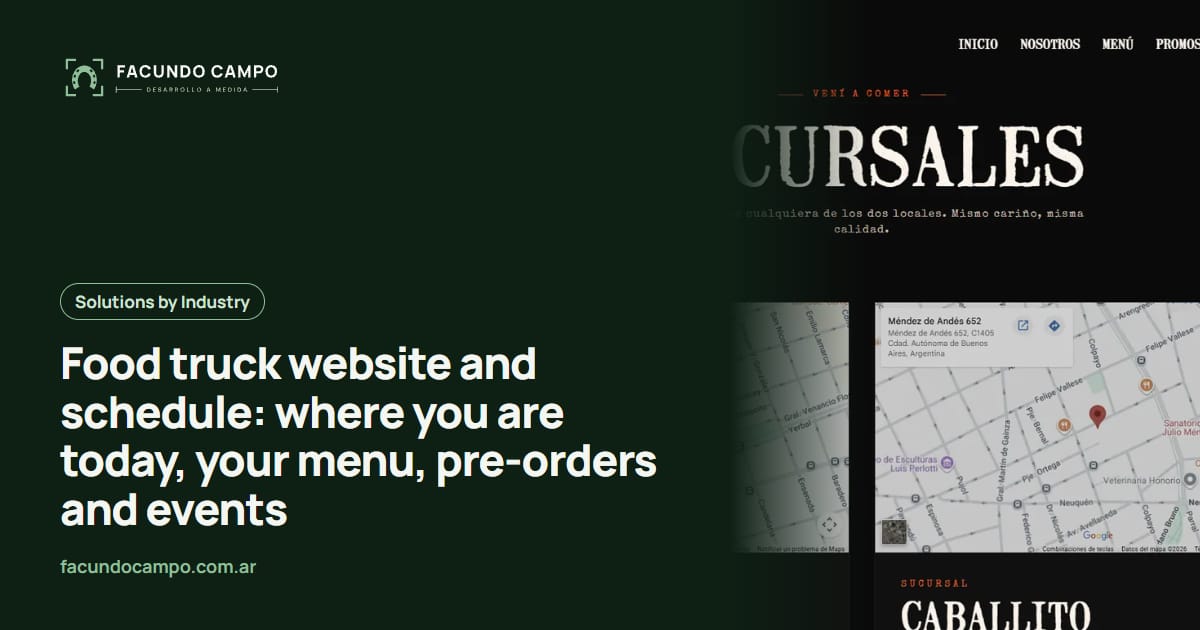
A food truck website has to answer one question before anything else: where are you today? Then come the menu, pickup pre-orders so people skip the line, and an easy way to book you for a wedding, an office party or a festival. If the site answers all that in a few seconds on a phone, it’s doing its job.
A restaurant has an address. You have a schedule. And right now that schedule probably lives in Instagram stories that disappear after a day, a pinned post nobody updates and a steady stream of “where are you guys today?” messages. Here’s how I build a website for a business that moves.
Why is the location schedule the most important part?
Because it’s what your regulars look for. Someone ate at your truck at a market, loved it, and wants to come back. If they have to scroll through a week of stories to guess where you’ll be, they’ll probably end up eating somewhere else.
The schedule shows today, tomorrow and the weekend: spot, hours and a button that opens directions. If rain cancels a day, you flag it from your phone and a notice shows up at the top of the page. You fill it in once a week and fix it when plans change, with nothing technical to touch.
Every recurring spot (the Saturday market, the Thursday brewery night) can also get its own page. That helps someone searching for “food truck at [that market]” find you on Google, the same way a restaurant shows up through its Google Business Profile.
What should a food truck website include?
- Where you are today, right at the top, with hours and a directions button.
- This week’s schedule: markets, public events and regular spots.
- Your menu, with real photos, and a quick way to mark what’s sold out today.
- Pickup pre-orders, so the office crowd can order ahead and skip the line.
- Event bookings, with a form that asks what you need to know to quote.
- A gallery of past events, so a company or a couple can see what your setup looks like.
How do pre-orders work?
At lunch near an office park, the line is your ceiling: once it gets long, people walk away. With pre-orders, customers pick their food on their phone and choose a pickup time. You see the orders come in on a screen, sorted by time. When they show up, they give their name and grab the bag.
It can work with or without upfront payment, and with a cap per time slot so the kitchen doesn’t get buried. I explain how I think about direct ordering for a regular restaurant in your own online ordering for restaurants. A truck works the same way, except the pickup spot changes every day.
How do people book you for events through the site?
Weddings, birthdays, corporate events and film shoots are often a truck’s steadiest income, and also where most of the back-and-forth on WhatsApp or text happens. A good form cuts a lot of that out: date, location, rough guest count, type of event, whether there’s power and water on site, and which menu they like.
You get the inquiry with everything you need to quote, and the person gets a confirmation that you received it. If you want, that date shows as “pending” on your calendar so you don’t promise the same day twice. I wrote more about getting people to actually finish those forms in contact forms that get filled.
A menu the owner updates on his own
In another food business, I built the website for Boca de Lobo, a steakhouse with two locations in Buenos Aires: a QR digital menu with more than 250 items, promotions and locations, plus a dashboard they use to change prices, dishes and promotions without calling me. You can see it at bocadelobo.com.ar.
For a food truck the idea is the same, with one difference: besides the menu, what changes every day is where you are. So the dashboard adds the location schedule.
See the Boca de Lobo projectWhat if you’re just getting started with the truck?
Start small: where you are today, the menu and a button to ask about events. That alone answers the question people ask you most. Pre-orders and the full event form can come later, once you’re busy enough to need them.
What does matter from day one is that the site is yours and you can update it yourself. I work remotely from Buenos Aires, Argentina, with progress shared by link and contact over WhatsApp or email, in English or Spanish, so you can review everything from the truck. You can see the rest of what I do on my services page.
Frequently asked questions
Can I change today’s location from my phone?
Yes. The dashboard is built to use standing next to the truck: pick the spot, the hours and save. The site updates right away, so anyone who opens it sees where you are today and where you’ll be this weekend.
Do I need this if I already post everything on Instagram?
Instagram is great for showing the food, but today’s location gets buried between stories and posts. A website puts what people actually need behind one link: where you are, what’s on the menu and how to book you. That link goes in your bio.
Do pre-orders get paid upfront?
That’s up to you. You can ask for just a name and pickup time, or take payment before you start cooking. We decide based on how busy you get and how much no-shows worry you.
How much does a food truck website cost?
I quote it per project, based on what you need: just the schedule and menu, or pre-orders and event bookings too. Send me a message about how you work and I’ll put together a proposal.
If you run a food truck and want people to know where you are without asking you every day, message me on WhatsApp at +54 9 11 6193-3176 or email contacto@facundocampo.com.ar. I answer in English and Spanish.