Horse farm management software: horse records, breeding, boarding and costs in one place
Horse farm management software keeps a record for every horse, the breeding and foaling calendar, boarded horses and what each animal costs. You know what to bill each owner and what every horse really costs the farm.
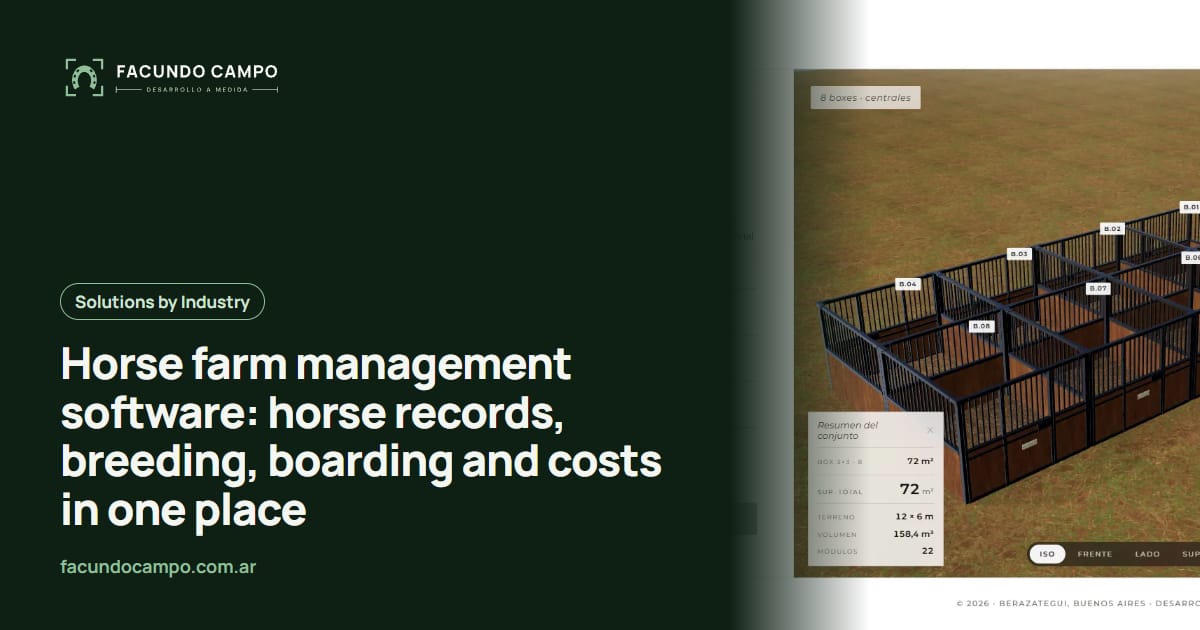
Horse farm management software keeps every horse's record, the breeding and foaling calendar, boarded horses and the costs of each animal in one place. It answers a question many farms can't answer quickly: what does this horse actually cost me, and what do I bill its owner this month?
I don't own a farm and I don't breed horses. I'm a developer who rides as a lesson student at a club on weekends, so I know the barn routine from the saddle side. From there, here's what this kind of software should handle and what's better left out.
You have the information. It's just scattered
On a horse farm, the data exists. It's in the barn manager's notebook, the vet's records, feed invoices stuffed in a folder, voice notes from the owner of a boarded mare, and the memory of whoever was there for the last foaling.
The day someone asks “when was the gray mare bred?” or “how much did we spend on the farrier last winter?”, somebody has to piece the story back together. And when a longtime employee leaves, part of that story leaves too.
What goes into each horse's record?
The horse record is the heart of the system. Breeding, costs and boarding all hang off it:
- Identity: name, color, sex, foaling date, sire and dam, markings and current photos.
- Owner: whether the horse belongs to the farm or a client, with contact details and their boarding agreement.
- Health: vaccines, deworming, lab work, vet visits and treatments, with a heads-up when the next one is due.
- Hooves and teeth: every farrier and equine dentist visit, so you know when the next one is due without flipping pages.
- Location: which paddock or stall the horse is in, when it arrived, and whether it left for a show, a sale or another property.
Breeding season, pregnancies and foals
For a breeding operation, the season is when things get messiest. Every mare has her own timeline: which stallion, live cover or AI, what the pregnancy checks showed, and when she's due.
The software tracks it as a timeline per mare. You log the breeding and it suggests the check dates. You log a positive check and it works out the due date. The dashboard shows which mares are due in the coming weeks, so the barn manager knows who to watch. When the foal arrives, its record is created already linked to the dam and sire, with nothing typed twice.
If you stand stallions to outside mares, the same records tell you what's been billed, what's pending and how each breeding turned out.
Boarding: the flat fee and the extras
| Item | How it's entered | What the owner sees at month end |
|---|---|---|
| Monthly board | Once, when the horse is added | The monthly charge, with no one typing it |
| Farrier or vet | From a phone, the day they come | Each visit with date and details |
| Supplements or special feed | As an extra for that horse, while it lasts | What was given and for how long |
| Hauling | When the horse leaves or arrives | The trip and where it went |
| Medication | With the treatment in the horse's record | What was used, tied to the treatment |
You set the billing rules (what board includes and what's extra). The software applies them the same way for every owner.
Cost per horse, not just total spending
Plenty of farms know their total monthly spend but not what each horse costs. In the software, every expense can go to one horse (a foal's surgery), a group (deworming a whole paddock) or the farm overall (new fencing). Shared costs get split however you decide.
That opens up questions you couldn't answer before: what it cost to raise a foal until it sold, whether your board rate covers what you spend, or which mare costs more than she brings in. You don't need an accountant to read it. It's plain lists and totals, and you can export them to a spreadsheet if your accountant asks.
Keeping owners in the loop without living on the phone
Owners of boarded horses want to know how their horse is doing. Sending a photo is easy. Answering the same question one owner at a time is what wears you down. From the horse's record, the software writes the message (the farrier update, the monthly summary, a vaccine reminder) and you send it by WhatsApp, text or email with one tap.
I built that kind of one-tap messaging for Mecohue, a pet shop with a vet clinic near Buenos Aires: its internal system handles appointments, the cash register and WhatsApp reminders. Different animals, same idea: the message comes out ready, and you decide when to send it. I wrote more about that in WhatsApp integration for business.
On the barn-building side: EQUIBOX
My closest project to the horse world is the 3D configurator for EQUIBOX, a horse stall and barn manufacturer in Buenos Aires province, Argentina. Their customers design a barn in 3D (size, model, walls and accessories), download the quote as a PDF and request it on WhatsApp. If your farm is about to add stalls, the Estructuras 3D blog has a piece on a horse stable 3D quoting tool, written for the companies that build them.
See the EQUIBOX projectBreeding farm, lesson barn, or both
Some farms also teach or keep lesson horses. That side works differently (lesson schedule, riders, how many lessons each horse does per day), and I covered it in riding school management software. Both can live in the same system and share the horse records.
I work on my own, remotely from Buenos Aires, Argentina (UTC−3), with video calls and progress you can open from a link. I start with whatever hurts most today, usually boarding or breeding season, and build from there. I quote each project separately, and you can see other work on my services page.
Frequently asked questions
Is it worth it for a farm with only a few horses?
Yes. With few horses the issue isn't volume, it's that everything lives in one or two people's heads. The software is built around what you actually use, and if you add boarders or broodmares later, that part gets added.
Can owners of boarded horses see anything?
If you want, yes: each owner can get a link to their horse's record, recent updates and what was charged this month. If you'd rather keep everything going through you, the system stays internal and you send the summary by WhatsApp or email.
Can I use it from my phone out in the barn?
Yes. The point is for the barn manager to log a deworming or an update right at the stall, not from memory at night. Quick-entry screens are designed to work one-handed.
Does it replace breed registry paperwork?
No. Registrations and breed association paperwork still go through their own channels. The software organizes the farm's internal records and keeps the details handy when you need them for that paperwork.
If you run a horse farm or a breeding operation and you're tired of rebuilding each horse's history from notebooks and voice notes, message me on WhatsApp at +54 9 11 6193-3176 or email contacto@facundocampo.com.ar. I answer in English and Spanish. Tell me how many horses you have and how you bill boarding, and I'll tell you where I'd start.