A website for a restaurant with multiple locations: what each location needs
If you have two or more locations, a website with a single WhatsApp number and a single address sends bookings to the wrong place and customers to the wrong door. I explain what each location needs and how I solved it for a grill restaurant with two locations in Buenos Aires.
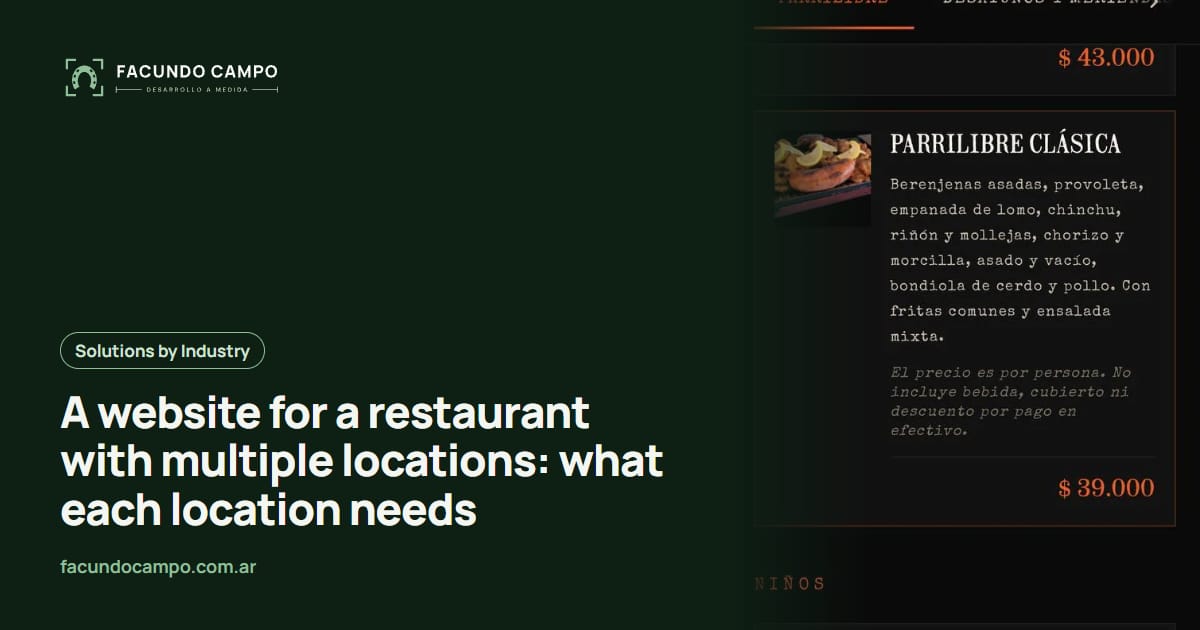
The website of a restaurant with multiple locations has to separate what belongs to each location (WhatsApp, bookings, delivery phone, address, map, reviews and links to delivery apps) and share what belongs to the brand, like the menu, the promotions and the story. That way every customer reaches the right location and you manage everything from one place.
I'll go over what each location needs, the mistakes that show up when everything is mixed together, and how I built it for Boca de Lobo, a parrilla (Argentine steakhouse) with locations in Floresta and Caballito, two neighborhoods in Buenos Aires.
What happens if the website has a single WhatsApp number and a single address?
In Argentina, WhatsApp is the main channel customers use to reach a business. With a single number, messages for both locations land on the same phone and someone has to keep forwarding bookings. A customer books in Caballito thinking it was Floresta. A delivery order goes to the location that is farther away. The good reviews of one location do nothing for the other.
With one location there is nothing to separate. With two or more, every contact detail in the wrong place is a lost booking or a customer at the wrong door. That is why the website has to be designed by location from the start, not as an add-on.
What does each location need on the website?
These are the details I would separate by location. They are the same ones each location has on the Boca de Lobo website:
- Its own WhatsApp, for questions and bookings, reaching the staff at that location.
- Bookings by location, with the location already selected so nobody has to clarify where they want to go.
- Its own delivery phone, if each location delivers to its own area.
- A "Get directions" button that opens Google Maps with that location's address, not the brand's.
- Its own Google reviews, which are what someone deciding whether to go to that location looks at.
- Its own PedidosYa and Rappi links (the main food delivery apps in Argentina), because each location usually has its own store on those apps.
- Opening hours and days, even if they are the same, visible without having to ask.
What is shared between locations and what is kept separate?
A simple rule: what identifies the brand is shared; what helps someone contact or reach a location is separate.
| Element | Shared or by location? | Why |
|---|---|---|
| Logo, look and feel, story | Shared | It is the brand. Customers should recognize it at any location. |
| Menu and promotions | Usually shared | They are entered once from the panel. If a location has something different, that can be accounted for when the system is built. |
| WhatsApp and bookings | By location | Each location gets its own inquiries. |
| Delivery phone | By location | Each location delivers to its own area. |
| Address and "Get directions" | By location | The map has to lead to the right place. |
| Google reviews | By location | Google stores them per location, and that is how people read them. |
| PedidosYa and Rappi | By location | Each location usually has its own store on the apps. |
How do you make sure a booking reaches the right location?
The simplest and most effective way is for the booking button to already know which location it was tapped from. On the Boca de Lobo website, when someone books from a location's card, WhatsApp opens with that location pre-selected: the message goes to that location's number and already says where the customer wants to go. Nobody has to ask or forward anything.
It looks like a detail, but it is exactly what keeps day-to-day operations in order when you have more than one location. If you take bookings over WhatsApp, every message that lands in the right place is one less back-and-forth.
How did I build it for a grill restaurant with two locations?
Boca de Lobo has locations in Floresta and Caballito, open every day. On its website, the locations section shows each one with everything it needs: bookings, WhatsApp, delivery phone, the "Get directions" button with Google Maps, that location's Google reviews and the links to order through PedidosYa and Rappi. There is also a floating WhatsApp button and links to Instagram, Facebook and TikTok.
What belongs to the brand, on the other hand, is managed once: the menu of more than 250 items, the promotions and the home page highlights are edited from their own admin panel. Before, there was no quick way to manage all those items across two locations; now they are changed in one place.
See the Boca de Lobo caseHow do you manage the menu and prices for multiple locations?
If each location had its own copy of the menu, every price increase would mean double the work, and sooner or later the menus would drift apart. With an admin panel, the menu lives in one place: you add an item, change a price or publish a promotion once, and the digital menu updates.
When the menu is long and prices move often, a bulk editor to change every price at once is also worth having. I explained it in how to update menu prices without depending on anyone. And if you want to see the options for the menu itself (PDF, platform or your own menu), they are in QR digital menus for restaurants.
What about Google? Each location has to be findable
To Google, each location is a separate place: it has its own address, hours, business profile and reviews. The website has to support that, with each location's details written correctly and matching what its profile says. If you want to go deeper, in local SEO for restaurants I explain what to check so people find you when they search for somewhere to eat nearby.
How much does a website for a restaurant with multiple locations cost?
It depends on how much you want to manage yourself. What drives the cost is how many locations and pages the site has, how long the menu is and whether you want your own panel to manage items, prices and promotions without depending on anyone. Tell me how many locations you have and how you work, and I'll send you a fixed quote within 48 hours over WhatsApp or email. What to look at when comparing options is in how much a website costs in Argentina, and what I offer is on my services page.
Frequently asked questions
Do I need a separate website for each location?
No. The most practical option is one website, with the brand, menu and promotions shared, and a locations section where each one has its own details: WhatsApp, bookings, phone, map and reviews.
How do I make sure a booking reaches the right location?
By making the booking button know which location it was tapped from. At Boca de Lobo, the WhatsApp booking opens with the location already selected, so the message reaches the right place.
Does each location need its own Google profile?
Yes. Google treats each location as a separate place, with its own address, hours and reviews. Ideally, each profile links to that location's section of the website.
Can I manage the menu for every location from one place?
Yes, with an admin panel. You change an item, a price or a promotion once and it updates on the digital menu, without repeating the work for each location.
If you have more than one location and everything lands on the same WhatsApp today, tell me how many locations you have and how you take bookings and orders. I'll suggest how to separate each location's details without multiplying the work.