Software developer in Atlanta: websites that bring in jobs and tools for crews in the field
I build websites and custom software for Atlanta and Georgia businesses remotely from Buenos Aires: sites that turn visits into booked jobs and systems that tell field crews what to do each day. Atlanta is only 1 to 2 hours behind Argentina, so we share almost the whole workday.
If you're looking for a software developer for a business in Atlanta or anywhere in Georgia, here's what I do: websites that turn visits into booked jobs, and custom software that tells your field crews what to do each day. I work remotely from Buenos Aires, which is just 1 or 2 hours ahead of Atlanta depending on the time of year.
Atlanta is full of businesses that grow fast: logistics companies around the airport and the interstates, home service companies covering the whole metro area, and shops going from one location to several. Here's where things usually get stuck in each case and what I'd build.
Home services: from the first call to the finished job
Plumbers, electricians, HVAC companies, cleaners, pest control and lawn care crews covering everything from Marietta to Decatur or Alpharetta: getting the first call is rarely the problem. What happens next is. The request comes in by phone, text or the website form, someone writes it on a notepad or a spreadsheet, and the tech finds out the address once they're already in the truck.
A website built for that customer does two things. First, someone searching Google on their phone understands in a few seconds which areas you cover, what you do and how to book. Second, the request arrives complete: address, type of job, photos of the problem and a preferred time window, so nobody has to call back to ask the basics. I went deeper in ranking in multiple cities as a service-area business, which is exactly what a company working all over metro Atlanta needs.
Software for field crews
Once the business grows, coordination becomes the bottleneck. Who's going to which house, at what time, with what materials? Did yesterday's job get finished or do we have to go back? Did the customer get the invoice?
A custom system sorts that out. The office builds the day's schedule, each tech sees it on their phone with the address and notes, uploads before-and-after photos and marks the job done. The owner sees what got done and what's pending on one dashboard, without chasing anyone on the phone. I wrote more about it in shared scheduling for field teams and work order management software.
Logistics and distribution
For a small logistics or distribution company, the usual headaches are deliveries coordinated through scattered texts, customers calling to ask where their order is, and signed delivery slips that get lost. A simple delivery system, with each driver's route for the day, a signature or photo at drop-off and a text to the customer when the order leaves, cuts down a lot of calls. I covered it in last-mile delivery tracking for small businesses.
Carport, shed and metal building sellers
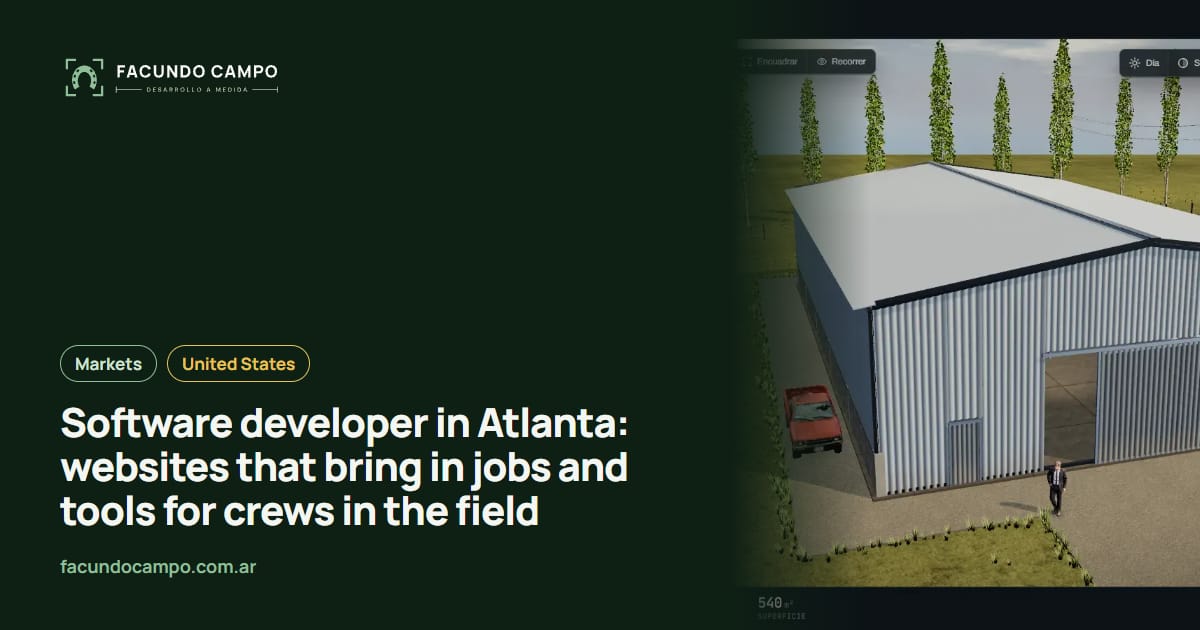
Georgia and the rest of the Southeast have plenty of carport, shed and metal building dealers. For them I built a 3D configurator demo where the buyer designs the structure and sends the order with every dimension; the Estructuras 3D blog has a piece on carport 3D quoting tools.
Where it usually makes sense to start
| Business | What usually gets stuck | First piece to build |
|---|---|---|
| Home services | Incomplete requests that need a callback | Website with a request form by area and service |
| Company with techs or crews | Daily schedule sent through texts | Job system that crews see on their phones |
| Logistics or distribution | Customers asking where their order is | Delivery tracking with texts and proof of delivery |
| Shop opening a new location | Each location with its own spreadsheet | One system for every location |
Working with me from Atlanta
The time difference is so small you'll barely notice it. We meet over video in your morning or afternoon, and progress reaches you as a link you can check whenever you have a minute. The process is always the same: a first call to understand how you work today, a written proposal split into stages, progress you sign off on before we move on, and everyday contact on WhatsApp or email, in English or Spanish.
You send me how your business runs, a few real job requests and whatever copy or photos you have; I hand over the website or system up and running, with a dashboard so you can manage it yourself. More on that in working with a remote developer. If you want to see a real tool that organizes incoming orders, take a look at Equibox, a manufacturer in Buenos Aires.
For contracts, taxes or customer data rules, check with a professional in the US.
Frequently asked questions
What's the time difference between Atlanta and Buenos Aires?
Atlanta is 1 or 2 hours behind Argentina, depending on the time of year. In practice we share almost the whole workday: a 10 a.m. meeting in Atlanta is 11 a.m. or noon for me.
Do you work in English or Spanish?
Both. Some business owners in Georgia prefer English and others Spanish; the proposal, meetings and updates happen in whichever you're most comfortable with. Your website can have both versions too.
Can you build a system for my techs or drivers?
Yes. I build custom systems where each person on the team sees their jobs for the day on their phone, uploads photos and marks work as done, while the office sees everything in one place. It works best to start with the part that wastes the most time today.
How do contracts and invoicing work?
I work with a written proposal split into stages you approve before we move on. The tax side on your end, like how to record payments to a foreign contractor, is something to check with your accountant in the US.
If you run a business in Atlanta, Savannah, Augusta or anywhere in Georgia, message me on WhatsApp at +54 9 11 6193-3176 or email contacto@facundocampo.com.ar. I answer in English and Spanish and quote each project separately. You can also use the [contact page](/en/contacto).