Hardware store inventory software: thousands of items, changing supplier prices, a fast counter
Hardware store software has to do three things well: find any item among thousands in seconds, apply a supplier's new price list in one go, and show what's in stock without walking to the back. Contractor accounts, job quotes and deliveries come on top, depending on the store.
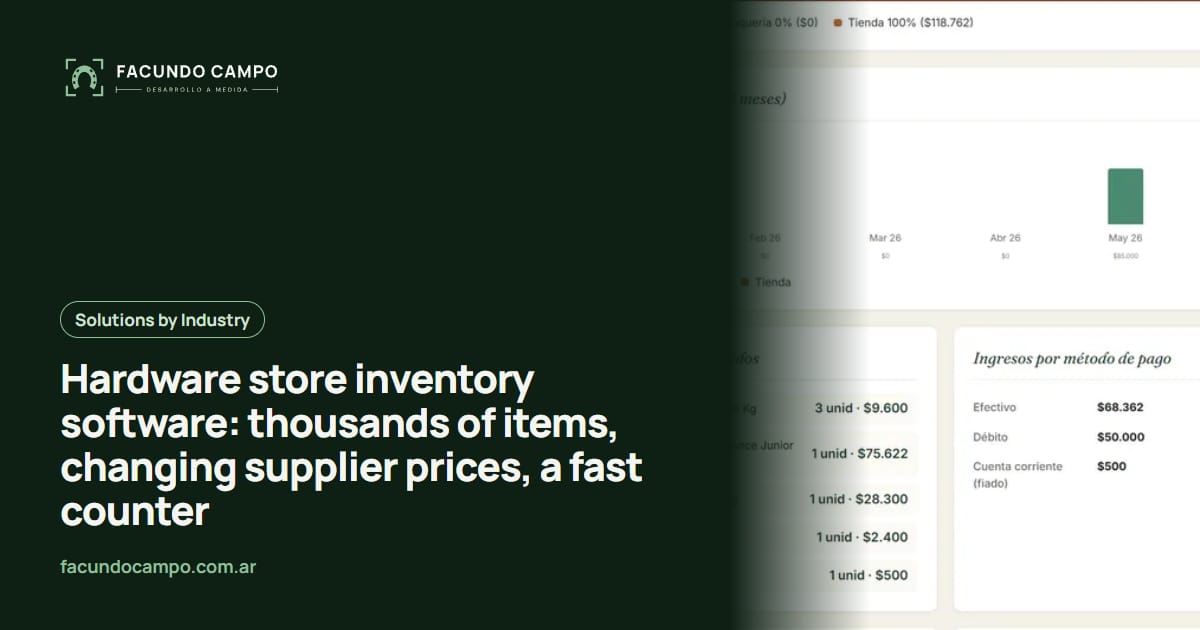
Hardware store inventory software has three jobs before anything else: find any item among thousands in seconds, apply a supplier's new price list without retyping it, and show what's in stock without someone walking to the back to check. Get those right and the counter runs smoothly.
Contractor accounts, job quotes and yard deliveries come next. But if the basics aren't solid, everything else is just decoration.
The counter doesn't forgive slow software
On a busy Saturday morning with a line forming, nobody at the counter can spend a minute hunting for “that quarter-inch brass coupling” or “the anchor that comes with the screw.” Customers ask for things the way they know them, not by the supplier's part number. Half the time they're holding the old part in their hand.
That's why search is the most important feature: it should find items by loose words, size, brand or supplier code, and show price, stock and which aisle or shelf it's on. A search that only works with the exact description is worse than nothing, because staff end up asking the owner, who's the only one who knows where everything is.
Supplier prices that keep moving
In a hardware store you don't set prices on your own. They depend on what each supplier charges you, and that cost changes often. Updating item by item is impossible, which is how stores end up selling below cost without noticing.
Software built for this keeps cost and selling price apart. You import the supplier's new list, the system updates the cost of every item from that supplier and recalculates selling prices using the markup you set for each category. Before you confirm, it shows what changed, so a typo in the supplier's file doesn't slip through.
I solved the same problem in a different industry: Boca de Lobo, a steakhouse in Buenos Aires, has a menu of more than 250 items and its own admin panel where the team updates prices without depending on a developer. A hardware store has far more items, but the idea is the same: the person who knows the prices changes them, with no middleman.
What a hardware store or building supply yard usually needs
- Different units of sale: each, box, foot, pound or bag, with stock deducted correctly.
- Reorder points: a heads-up when something drops below the level it should never go under, so you can build the supplier order.
- Contractor accounts: builders, plumbers and electricians who pick up during the month and pay later, with a record of what they took and for which job.
- Job quotes: a materials list for a customer who hasn't bought yet, which turns into a sale with one tap if they say yes.
- Yard deliveries: what goes on each truck, to which address, and what's still pending.
Neighborhood hardware store vs building supply yard
| Topic | Neighborhood hardware store | Building supply yard |
|---|---|---|
| Typical sale | Lots of small, quick sales | Fewer, bigger sales |
| What matters most | Search and checkout | Quotes, contractor accounts and deliveries |
| Regular customer | Homeowners and local tradespeople | Builders and job-site buyers |
| Inventory | Huge variety, small quantities | Less variety, high volume |
A real counter business: Mecohue
Mecohue is a pet shop with a vet clinic and grooming salon near Buenos Aires. Its website has a product catalog, and its internal system handles the cash register, appointments and one-tap WhatsApp messages. Different industry, similar counter problem: lots of products, quick sales, and needing to know at closing time what came in and what went out.
See the Mecohue projectWhat about selling online?
Plenty of hardware stores want to sell online, but order matters: first the system with items, prices and stock in one place, then the online store that pulls from it. Do it the other way around and you end up with two price lists that never match. I wrote about it in online store for hardware stores and keeping online and in-store inventory in sync.
And if your yard also sells carports, sheds or steel buildings, Estructuras 3D shows how a customer can design the structure in 3D and request a quote with the exact size they want.
How we'd get started
First I look at how you work today: what software or spreadsheet you use, how supplier price lists reach you, and what eats most of your time. From there I build a first version with search, price lists and stock, you use it at the counter, and we adjust. I work remotely from Buenos Aires, Argentina (UTC−3), over video calls. More work on the projects page.
Frequently asked questions
I have thousands of items. Who enters them?
Almost never by hand. Supplier price lists usually come as spreadsheets, and they get imported with code, description and cost. Shelf locations and real stock counts get filled in over time, starting with your best sellers.
Can it handle items sold by the foot, by weight or loose?
Yes. Each item has its unit of sale and, when needed, a conversion: the box of screws you also sell loose, the spool of wire you sell by the foot. Stock is deducted in the right unit.
Does it handle invoicing and sales tax?
Tax and invoicing rules depend on where you are, so check with your accountant. Usually the system builds the sale and connects to the invoicing tool you already use, or you keep a separate tool for that and the system handles everything else.
What if I want to sell online later?
If your items, prices and stock are already organized in the system, the online store comes straight from there. That's the best way to avoid two different price lists.
If you run a hardware store or supply yard and price updates eat your week, message me on WhatsApp at +54 9 11 6193-3176 or email contacto@facundocampo.com.ar. I answer in English and Spanish. Send me a sample supplier list and I'll show you how I'd organize it.