Logistics company website in Panama: bilingual site, shipment tracking and quote requests
A website for a logistics company in Panama has to speak Spanish and English to customers across the region, let each one see where their cargo is and take quote requests with complete details. I build it remotely from Buenos Aires.
A website for a logistics company in Panama has three jobs: speak Spanish and English to customers from all over the region, let each one see where their cargo is without calling, and take quote requests with complete details so you can reply fast. I build it remotely from Buenos Aires, for freight forwarders, free zone operators, warehouses and couriers.
Here's what each kind of customer looks for and how to set up the site to serve all of them.
Customers who could be in any country
Panama makes its living moving things from one place to another: the Canal, the ports of Balboa and Colón, Tocumen airport, the Colón Free Zone and Panamá Pacífico. A logistics company there might have, in the same week, an importer in Colombia, a Central American buyer consolidating in the free zone, an exporter in China and a customer in the US.
That customer reaches your site from a search or a referral and wants to know quickly what services you offer, from and to where, which cargo you handle and how to request a quote. If the site is only in Spanish, English readers move on. I explain how to do two languages well in bilingual website for small business.
What a logistics company website should include
- Services explained for the customer: ocean, air and land freight, warehousing, re-export, customs clearance, distribution.
- Usual routes and origins in general terms, without promising transit times you don't control.
- The cargo types you handle and the ones you don't, to filter out inquiries that aren't a fit.
- A quote request form asking for origin, destination, cargo type, approximate weight or volume and date.
- Shipment tracking by number or login, so customers don't have to write in.
- Direct contact with an account rep, on WhatsApp and email, and the languages they handle.
Shipment tracking: fewer calls, more trust
The question that comes up most in logistics is “where's my cargo?”. Every time a customer has to write to find out, someone on your team drops what they're doing to look it up. And if the answer takes a while, the customer gets nervous.
A tracking page lets customers enter their number or log in and see what stage their shipment is at: received at the warehouse, in transit, at port, in customs, ready for pickup or delivered. Your team updates the status from the dashboard in one click, and the customer can get a WhatsApp or email alert each time it changes. More on the idea in order tracking page for customers.
Quote requests that arrive complete
A message that says “I need a quote for a container” means five questions before you can answer. A form built for your business asks for what you need from the start: origin and destination, cargo type, full container or consolidated, approximate weight or volume, estimated date, and whether it needs warehousing or clearance.
The request reaches your inbox or dashboard in order, assigned to the right rep, and you can see which ones were answered and which weren't. No inquiry gets forgotten in someone's inbox. To see how a quoting system grows from there, have a look at quote software for service businesses.
A portal for your regular customers
Customers who ship every month need more than a tracking page. They want to see all their shipments, download documents, check invoices and request a new quote without retyping their details. A customer portal with a login gives them that and saves your team a lot of email.
I cover it in B2B customer portal. And if you run a warehouse in the free zone or in Panamá Pacífico, keeping track of what comes in and goes out is in warehouse management for small business.
Requests that arrive complete: EQUIBOX
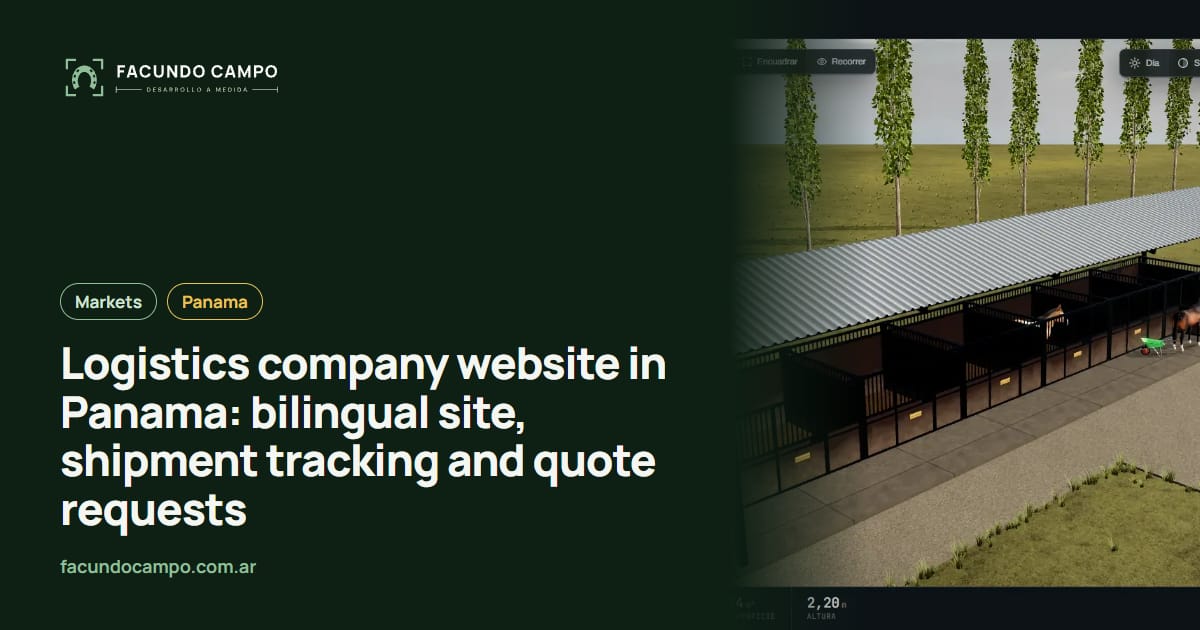
I don't have logistics companies as clients. Getting inquiries in with every detail, though, I've solved in another field: with the EQUIBOX configurator, built for a horse stall manufacturer in Berazategui, Buenos Aires, customers design their barn with dimensions and accessories, download the spec sheet and ask for a quote on WhatsApp. The sales rep gets everything needed to quote without extra back-and-forth.
See the EQUIBOX projectWorking with me from Argentina
Panama is 2 hours behind Argentina all year, so we share most of the workday. We start with a video call in English or Spanish to understand your services, your customers and how inquiries reach you today. You send copy, photos of your facilities and the shipment stages you use, and I build the site in stages you review from a link.
At the end it's live, with a dashboard to update shipments, answer quote requests and change content. Customs, regulations and contracts are for you and your advisors. More on how I work with companies there in software developer in Panama.
Frequently asked questions
Can customers see the status of their shipment?
Yes. Each customer logs in or enters a tracking number and sees what stage their cargo is at, with dates and, if needed, attached documents. Your team updates the status from the dashboard, or it can connect to the system you already use.
Can the website give automatic freight rates?
It depends on your business. In most cases freight is quoted by origin, destination, cargo type and service, so a form that asks for exactly those details and lets you reply quickly with a proper quote usually works better.
Do you work in English?
Yes. I work in English and Spanish, for meetings and for the website copy. If you need another language, such as Portuguese or Chinese, it can be added if you supply the copy.
What's the time difference with Panama?
Panama is 2 hours behind Argentina all year. An 8 a.m. meeting in Panama City is 10 a.m. for me.
If you run a logistics, freight or warehousing company in Panama City, Colón, Panamá Pacífico or anywhere in Panama, message me on WhatsApp at +54 9 11 6193-3176 or email contacto@facundocampo.com.ar. I answer in English and Spanish and quote each project separately. You can also use the [contact page](/en/contacto).