Online store for handmade products: your story, one-of-a-kind pieces and custom orders
An online store for handmade products has to sell something a standard store isn't built for: the craft itself. It shows who makes each piece and how, handles one-off items that sell only once, and takes custom orders with all the details, a deposit and a realistic lead time.
An online store for handmade products has to sell something a standard store isn't built for: the craft. Someone buying a wheel-thrown mug, a hand-carved spoon or a hand-stitched leather bag isn't just buying an object. They're buying who made it, how, and why it's different. If the store presents it like a factory product, it loses the very thing that makes it worth the price.
Handmade work also brings two problems generic stores handle badly: one-of-a-kind pieces that sell exactly once, and custom orders with no fixed price or lead time. Let's take them one at a time.
Telling your story without writing a novel
The story doesn't belong in an About page nobody reads. It goes where people make up their minds: a photo of your hands at work on the product page, one line about the material (“vegetable-tanned leather,” “hand-glazed stoneware”), a short process video, and a studio page with your face and your workspace. A few well-placed pieces say more than a long text.
Photos are half the sale: the piece alone on a plain background, the piece in use, and a close-up of the finish. If you're shooting them yourself on a phone, I shared tips in photos for your business website. To make those photos bring in Google traffic too, see image SEO for online stores.
One-of-a-kind pieces: sold once, no stock mix-ups
When every piece is unique, the biggest risk is selling it twice: once online and once at Saturday's market, or to two people on the site at the same moment. The store has to treat each piece as a single item, hold it while someone pays and mark it sold as soon as the order goes through.
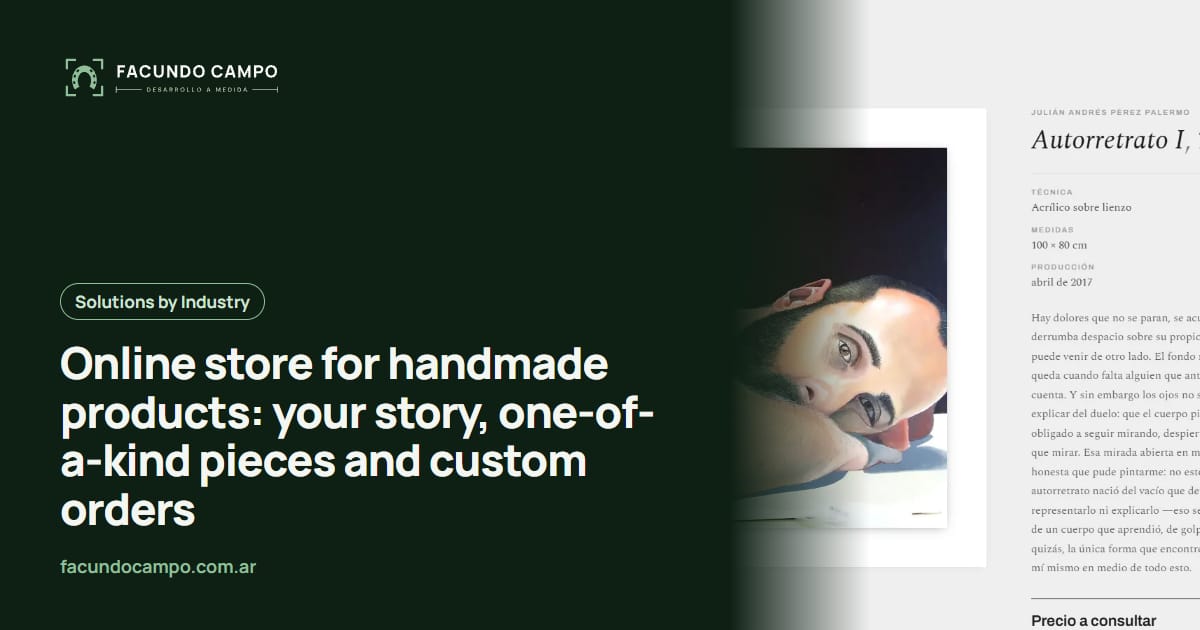
Once it's sold, don't delete it. A sold piece still shows what you make and opens the door to a similar order: “this one's gone, want one like it?” It's the same logic as an artist's catalog. Pérez Palermo, a visual artist in Argentina, has a website with his work organized by period and a page for each piece, which he uploads himself.
Custom orders, organized from the first message
What eats your time isn't making things. It's the back-and-forth to figure out what the customer wants. A custom order form fixes that if it asks for just enough:
- Which piece it's based on: “this board, but bigger,” with a link to the product page.
- The options you actually offer: size, color, wood, glaze or whatever makes sense, as fixed choices so nobody asks for the impossible.
- Engraving or lettering, typed by the customer so spelling mistakes are on them, not you.
- A reference: the customer can upload a photo of what they have in mind.
- When they need it, with your real lead time shown before they confirm.
- A deposit to get started, with the balance on delivery.
Honest lead times and deliveries that arrive in one piece
If your work takes time, say so on the product page and in the cart: “made to order, ships in about this long.” People who know up front wait calmly; people who find out later send worried messages. When orders pile up, the store can push the lead time out automatically instead of you editing every page.
For fragile work like ceramics or glass, it's often smart to limit delivery to your area or to methods you trust, and offer pickup at your studio or your market stall. I covered how to set up areas in local delivery zones for an online store.
Catalog or full store?
If nearly everything you make is commissioned, you might not need a cart at all: a catalog with product pages and a button that messages you on WhatsApp can be enough. I compared both in online catalog without checkout. If you have finished pieces in stock plus special orders, a store that handles both is the way to go.
Manufacturers of made-to-order products face the same challenge on a bigger scale: selling to someone who can't touch the product before ordering it. I wrote about that in selling made-to-order products remotely. And if you're just getting started, read a website for new businesses.
Frequently asked questions
Do I need my own store if I already sell at markets and on Instagram?
Yes, and all three work together. Markets and social media get you discovered. Your store is where everything is organized, with prices, sizes and lead times, and where someone who met you at a fair can buy again without scrolling through your posts.
How do I handle products I make in batches?
They can show as “next batch” with an estimated date, so people can reserve or leave their contact. When the batch is ready, you let them know and the stock opens up.
Can I take a deposit on custom orders?
Yes. A custom order can ask for a deposit when it's confirmed and leave the balance for delivery. You decide how you collect it; the store keeps a record of what was agreed with each customer.
Who adds new products?
You do, from your phone if you like. Makers add pieces all the time, so uploading has to be simple: photos, description, size and price, with no extra steps.
If you make things by hand and want a store that shows your craft and keeps custom orders organized, message me on WhatsApp at +54 9 11 6193-3176 or email contacto@facundocampo.com.ar. I work remotely from Buenos Aires (UTC−3), answer in English and Spanish, and quote per project. Tell me what you make and how you sell today.