Software developer in Costa Rica: bilingual websites for hotels, tours and small businesses
I build bilingual websites, booking systems and custom software for businesses in Costa Rica, remotely from Buenos Aires, three hours ahead of San José. Boutique hotels, tour operators, restaurants in beach towns and small companies in the Central Valley are where it pays off most.
If you're looking for a software developer for a business in Costa Rica, here's how I work: I build bilingual websites, booking systems and custom software, remotely from Buenos Aires, three hours ahead of San José. I work on my own, in English and Spanish, with video calls and progress you open from a link.
A lot of Costa Rican businesses sell to people who don't speak Spanish: the tourist landing in Guanacaste, the traveler booking a tour in La Fortuna, the expat who moved to Nosara or Santa Teresa. Plenty of those businesses are also run by foreigners who settled there. That's why almost everything I build for Costa Rica starts with a site in two languages. Here's what each kind of business needs.
Boutique hotels and cabinas: direct bookings
A boutique hotel in Santa Teresa, a set of cabinas (Costa Rica's word for small, simple lodging) in Puerto Viejo or an eco-lodge in Monteverde lives on bookings, and many of them come through platforms that keep a cut of each one. Your own website doesn't replace those platforms, but it gives you a direct channel for guests who already know you or find you on Google.
For that, the site has to show your rooms, photos, location and what's nearby, in English and Spanish, with a simple way to check availability and book. I go into detail in website for small hotels and cabins and bilingual website for small businesses.
Tour operators and rentals: the calendar rules
A zipline operator near Arenal, a surf school in Tamarindo or an ATV rental in Jacó all share a problem: limited spots per time slot, groups that change at the last minute, and inquiries in English over WhatsApp at all hours. If all that lives in a paper planner, bookings overlap.
A booking system with spots per departure, automatic confirmation and a reminder the day before sorts it out. If you rent gear (boards, kayaks, bikes), equipment rental software tells you what's out, what's due back today and what's being repaired. And an appointment reminder system cuts down on no-shows.
A real case: Boca de Lobo's digital menu
Boca de Lobo is an Argentine steakhouse with two locations in Buenos Aires. Its website has a QR digital menu with more than 250 items, promotions and locations, plus its own dashboard where the staff change prices, dishes and promotions without calling the developer.
A restaurant in Tamarindo or a beachside soda (a small, casual local eatery) with foreign customers can have the same thing, with the menu in English and Spanish: the tourist scans the QR code and reads in their language, and you change the daily special from your phone.
See the Boca de Lobo caseReal estate and developers: the overseas buyer
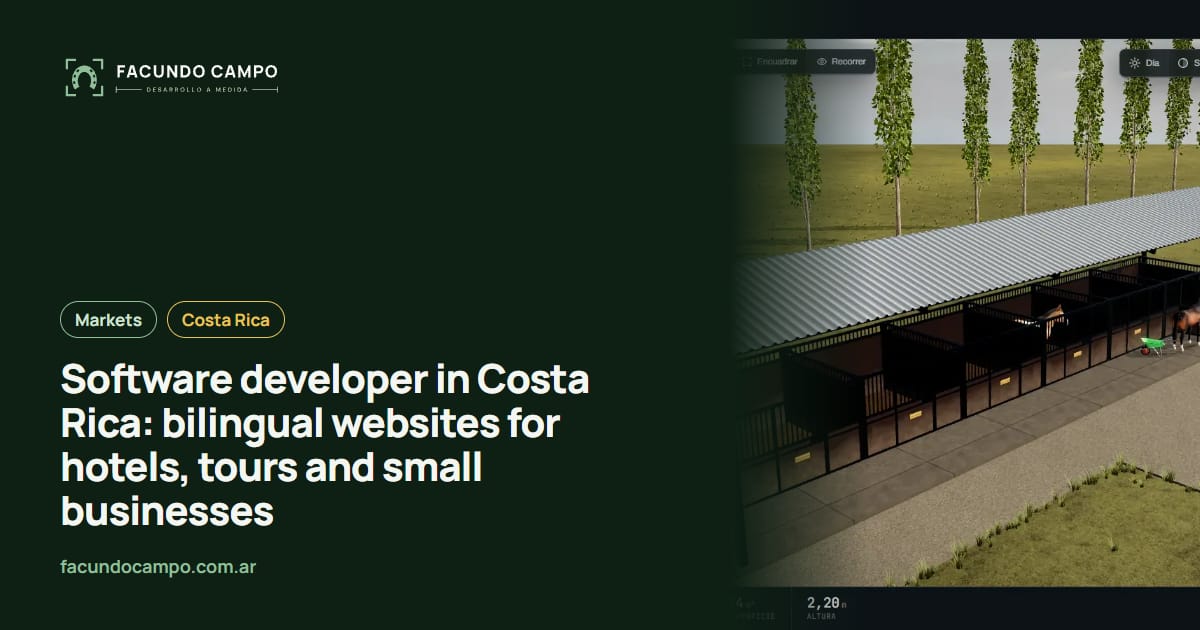
In Guanacaste and the southern Pacific, villas, condos and lots are sold to buyers living in the US, Canada or Europe. That buyer can't fly down to see every project; they need to understand it from home. That's why I built Recorrido 3D, my product for interactive 3D walkthroughs that help sell homes and condos before they're built. Its blog has a piece on 3D renderings and walkthroughs in Costa Rica. If you're a builder selling home models, there's another on a 3D configurator for builders in Costa Rica.
Small companies in the Central Valley: custom software
San José, Escazú, Heredia and Cartago are full of distributors, workshops, clinics and service companies that grew on spreadsheets and now need something more organized. Custom software puts customers, orders, stock and payments in one place, with a login for each employee. If you're not sure it's time, read from spreadsheets to custom software.
Working with me remotely from Costa Rica
Costa Rica is three hours behind Argentina all year. We start with a video call in your morning, I send a written proposal, and then you follow progress from a link. You sign off on each stage before we move on, and day-to-day contact is by WhatsApp or email, in English or Spanish, whichever suits you or your business partner.
What you send: photos, your list of rooms, tours or services, and how you take bookings today. What you get: the website or system up and running, with a dashboard to update prices, availability and photos yourself.
If your site collects guest or customer data, or you need electronic invoicing, check with a local professional what Costa Rican rules currently require. I build the software to follow whatever they recommend.
Frequently asked questions
What's the time difference between Costa Rica and Argentina?
Costa Rica is three hours behind Argentina all year. If you message me at 9 a.m. in San José, it's noon in Buenos Aires, so we share your whole morning and a good part of the afternoon.
Who writes the English copy?
I do, based on what you tell me about your business, and you review it. I write directly in English instead of translating word for word. If you want another language, like French or German, you provide that copy.
Can I stop depending on booking platforms?
You don't need to drop them. The goal is for part of your bookings to come to you directly. A website of your own, easy to find and easy to book on, gives you that channel alongside the platforms.
Can the system issue electronic invoices?
Usually it connects to the service you already use for invoicing instead of replacing it. What Costa Rican rules currently require for your business is something to check with your accountant.
If you run a hotel, tour company, restaurant or small business in Costa Rica and want a bilingual website or a system of your own, message me on WhatsApp at +54 9 11 6193-3176 or email contacto@facundocampo.com.ar. I answer in English and Spanish and quote each project separately. You can also use the [contact page](/en/contacto).