Website for small hotels and cabins: more direct bookings, fewer commissions
Your own website won't replace the booking platforms, but it gives guests a way to book with you directly: live availability, photos of every room or cabin, and an online deposit. Returning guests, and those who found you on a platform and then look up your name, can book without a middleman.
A website for a small hotel or a set of cabins isn't there to replace the booking platforms. It's there to give guests a way to book with you directly. With live availability, photos of every unit and an online deposit, guests who already know you can book without a commission taking a cut of every night.
This is for small hotels, cabin rentals, hostels and guesthouses, where the owner answers the phone, cleans, checks people in and still has to remember to update several calendars.
The guest who looks you up by name
It happens all the time. Someone finds your cabins on a booking platform, likes them, and before booking they search your name on Google. They want more photos, directions, or just proof that you're real. If they find a clear website with a book now button, plenty of them book right there.
Then there are the people who have stayed before: the family that comes back every summer, the couple who returns for the long weekend, the friends who recommend you. None of them need a platform to find you. They need an easy way to see your open dates and book without a long back and forth.
What a lodging website needs
- A page for each unit: every cabin, room or dorm with its own photos, how many people it sleeps, beds, kitchen, grill, view.
- Live availability: guests pick dates and see what's free.
- Booking with an online deposit, with the cancellation policy shown before they pay.
- Real directions: which highway, whether there's a dirt road, where to get gas, what to do if you arrive after dark.
- Things to do nearby: beaches, trails, wineries, fishing, places to eat. It's what people check before deciding.
- House rules: check-in and check-out times, pets, quiet hours, linens.
Photos of each cabin, not just the brochure shots
The most common mistake is showing the same five pretty photos of the property and none of what the guest will actually use. If you have cabins for two and cabins for six, each needs its own photos: bedroom, bathroom, kitchen, porch, and the view from the window. That's the difference between a booking and a message asking can you send me pictures of the big one?
Add seasonal photos too: the property in snow, the pool in summer, the fireplace going. People booking in winter want to see winter.
High season, low season and holiday weekends
Lodging rates, minimum stays and specials change with the season. If every change means calling someone to edit the site, it ends up out of date exactly when it matters most. So I build it for you to change seasonal rates, a holiday-weekend minimum stay or a midweek special from a simple admin page. More on that in self-managed websites.
In a different industry, Boca de Lobo, a steakhouse in Buenos Aires, changes prices, dishes and specials from its own admin page without calling the developer. For a small hotel, that independence is worth just as much.
Google, reviews and guests from abroad
Most travelers check the map first. A complete Google Business Profile, with current photos and a link to your site, sends many of them straight to you. Reviews matter too: a friendly message the day after checkout with a direct link to leave one adds up.
If you host international guests, a second language stops being a nice extra. I wrote about it in bilingual websites for small businesses.
If you're building new cabins
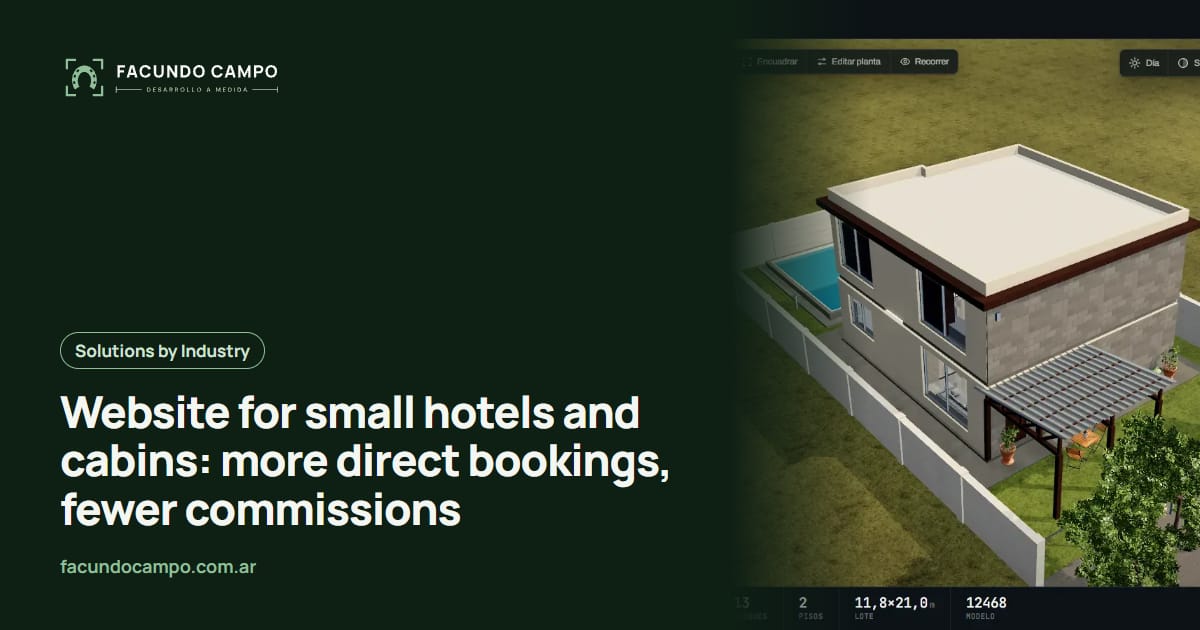
Many properties grow one cabin at a time. With Recorrido 3D, my interactive 3D walkthrough product, a new unit can be shown before it's finished, so you can start taking bookings or pitch it to an investor.
If you're planning a new building, the Recorrido 3D blog has a piece on renderings for hotels and condo hotels.
See Recorrido 3DHow we'd work together
I work on my own, remotely from Buenos Aires (UTC−3), with video calls and progress you can check through a link, so it doesn't matter whether your place is on the coast, in the mountains or across the world. You send photos, your list of units and how you handle bookings today; I build the site and show you every step. I quote each project separately, in English or Spanish.
Frequently asked questions
Do I have to stop listing on booking platforms?
No. Platforms bring you guests who don't know you yet, and that has value. Your own website is for returning guests, referrals and people who look you up by name. The two work side by side.
How do I avoid double bookings?
Your website calendar can sync with the platforms' calendars: when a booking comes in on one side, those dates get blocked on the other. It's still worth checking the calendar often, especially in high season.
Can guests pay a deposit online?
Yes. Guests pay the deposit with the payment methods you already use and the booking is confirmed. You set the cancellation policy, and it's shown before they pay. For taxes and invoicing, check with your accountant.
Can the site be in more than one language?
Yes. I write websites in English and Spanish, each version written for its reader. If you need another language, it can be added with text you provide.
If you run a small hotel, cabins or a hostel and want more direct bookings, message me on WhatsApp at +54 9 11 6193-3176 or email contacto@facundocampo.com.ar. Tell me how many units you have and how guests book today.