Software developer for Guatemala: systems for distributors, small businesses and retail
I build custom software, websites and apps for small businesses in Guatemala, remotely from Buenos Aires, three hours ahead. Distributors that supply the country and Central America, retailers and Antigua tourism businesses are where it pays off most.
If you're looking for a software developer for a small or mid-sized business in Guatemala, here's how I work: I build custom software, websites and apps remotely from Buenos Aires, three hours ahead of Guatemala City. I work on my own, in English or Spanish, and you follow the progress from a link on your phone.
In Guatemala, many companies in the capital sell across the country and into neighboring markets. That shapes one very specific kind of business, the distributor with reps on the road, and that's where software of your own changes the most. I'll also cover what works for neighborhood retail, manufacturing and tourism in Antigua.
Distributors: from a warehouse in the capital to routes across the country
The usual picture: a warehouse in the capital's industrial area or in Mixco or Villa Nueva, reps driving out to Quetzaltenango, Escuintla, Cobán or the border, and customers (corner grocery stores, hardware stores, pharmacies) ordering by phone or WhatsApp. Prices change, the rep is carrying an old list, and nobody at the warehouse knows what's already been promised.
What usually fixes it, in this order:
Where to start if you run a distribution business
- A field sales app with catalog, prices and orders that works in areas with no signal.
- An inventory system for distributors that shows what's in the warehouse and what's already reserved before you promise a delivery.
- A wholesale ordering portal where repeat customers order on their own, whenever they want.
- Delivery zones and routes by day, so the truck leaves with orders grouped instead of guessing.
Selling across Central America without losing track
Plenty of Guatemalan distributors and manufacturers also sell to El Salvador, Honduras and beyond. That brings customers with different terms, price lists by country and orders shipping out of the same warehouse. When it all lives in spreadsheets, each country ends up as its own spreadsheet.
Custom software can keep one customer and product database with prices and terms by country, and show each buyer only what applies to them. Taxes and export paperwork are for your accountant or customs broker to define; the software follows their lead. If you're wondering when it's worth making the jump, I covered it in from spreadsheets to custom software.
Metal building manufacturers and construction
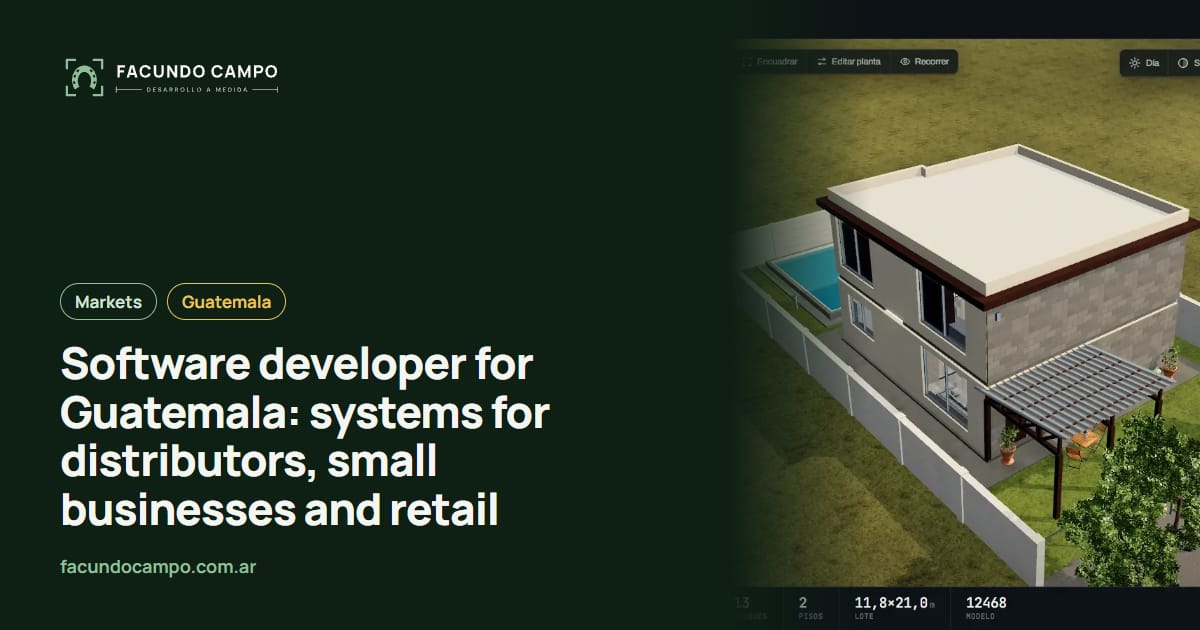
Companies that sell metal buildings, warehouses, steel canopies and structures get inquiries like “how much for a warehouse?” with no dimensions at all. A 3D configurator lets the customer design it (length, width, height, roof, doors) and send you the full order, so your sales rep starts the conversation with real numbers. The Estructuras 3D blog has a piece on 3D quoting tools for manufacturers in Central America. And if you're a developer selling condos off the plan in Guatemala City, take a look at 3D renderings and walkthroughs in Central America.
Antigua, Atitlán and tourism that searches in English
Antigua Guatemala, Lake Atitlán and Quetzaltenango are full of boutique hotels, tour operators, specialty coffee shops and Spanish schools for foreigners. Their customers search in English, on their phones, before they travel. A bilingual site with photos, what each option includes, how to get there and a WhatsApp button is usually what pays off most.
For a Spanish school, that might be a sign-up form that asks for level, dates and whether the student wants a homestay, and arrives organized. For a hotel, it's letting past guests book directly. I wrote more about it in bilingual website for small business.
Working with me remotely
I'm three hours ahead of Guatemala. In practice, your morning is my midday and afternoon: a 9 a.m. call in Guatemala is noon for me. We get solid overlap every day.
We start with a video call to understand your business, I send a written proposal, and then you see progress from a link. You sign off on each stage before we move on, and everyday contact is on WhatsApp or by email. You send your product list, prices, customers and how your team works today; I hand over the software up and running, with a dashboard so you can manage it yourself. More detail in working with a remote developer.
For invoicing, customer data or rules specific to your industry, check with a local professional.
Frequently asked questions
What's the time difference between Guatemala and Argentina?
Three hours: when it's 9 a.m. in Guatemala City, it's noon in Buenos Aires. Neither country changes its clocks, so it's the same all year. The easiest slot is early in your morning, which is late morning or midday for me.
Does it work if I also sell in El Salvador or Honduras?
Yes. The software can handle customers, price lists and delivery zones across several countries. Whatever changes from country to country in taxes or customs paperwork is best defined with your accountant or customs broker, and I build it to follow that.
Can it connect to the e-invoicing I already use?
Often yes, but it depends on how you issue invoices today and what Guatemalan rules require for your case, so check with your accountant. The usual approach is to connect the software to what you already use, not replace it.
Can my reps use it without a signal?
Yes. It can be built so reps take orders in areas with poor coverage, and the orders go through on their own once they're back online.
If you run a distributor, a store, a factory or a tourism business in Guatemala, message me on WhatsApp at +54 9 11 6193-3176 or email contacto@facundocampo.com.ar. I answer in English and Spanish and quote each project separately, so tell me how you work today and we'll figure out where to start. You can also use the [contact page](/en/contacto).