Website for architects: a project portfolio with big photos that still loads fast
An architecture studio's website is, above all, its portfolio: large photos, a page for every project, and navigation that lets the work speak. The challenge is making those photos look flawless and still load fast on a phone.
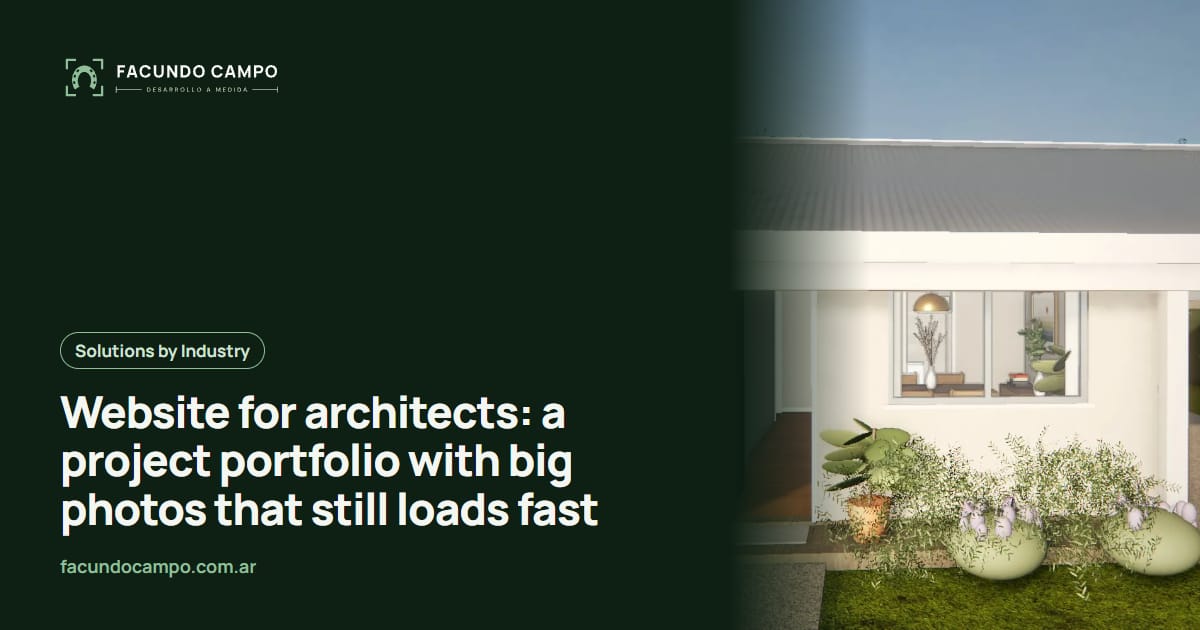
A website for architects is, above all, a portfolio: large photos, a page for every project, and navigation that lets the work do the talking instead of the website's design. The technical challenge, which is my problem and not yours, is making those photos look flawless and still load fast on the phone of someone who heard about you from a friend.
Here's what to show, how to organize it, and where studio websites tend to go wrong.
Beautiful photos that take forever
Architects invest in professional photography, and rightly so: it's the best way to tell the story of the work. The trouble starts when those files go straight onto the site. A full-screen hero image that takes ages to appear, a gallery that loads in chunks while the visitor scrolls, a phone on a weak connection that just gives up. Someone who came to see your work leaves before they see it.
The fix isn't lowering the quality. It's preparing each image properly. The site keeps the original photo and creates versions in different sizes: phones get the light one, big screens get the heavy one, and photos further down load only when the visitor reaches them. I wrote more about this in why website speed matters.
What every project page should include
Beyond the photos, this is what turns a gallery into a portfolio:
- The basics: project type, general location, year, and floor area if you want to share it.
- The project text: the idea, the site or client constraints, and how you solved them. Short, and written so someone who isn't an architect can follow.
- Plans and sketches: they tell colleagues and the most engaged clients what a photo can't.
- Credits: photographer, team, collaborators and contractor. It's fair, and it builds trust.
- Status: built, under construction, unbuilt or competition entry, so nobody mistakes a rendering for a photo.
How to organize your projects
Every studio has its own logic, and the site should follow it. Some sort by program: residential, commercial, interiors, public space. Others sort by year, so people can see how the practice has evolved. Many combine a homepage with the most representative projects and a full index with filters.
What doesn't work is an endless grid of photos with no context. A homeowner looking for an architect wants to see houses, fast. Someone coming from a magazine feature wants to find that one project. A good index serves both.
A real project with an artist: work by period, a page for each piece
For the painter Pérez Palermo I built a website with his catalog organized by period and a page for every piece, which he uploads himself. It's not architecture, but the problem is very close: a large body of work that has to look good, organized with a clear logic, and easy to update without calling the developer. I told the story in a painter's website.
See the Pérez Palermo projectWho each part of the site is for
| Visitor | What they want | What the site shows them |
|---|---|---|
| Homeowners planning a house | Similar homes and how you work | Residential projects and a page about your process |
| Developers or companies | Scale, timelines and team | Larger projects, your team and services |
| Colleagues or press | One project with plans and credits | A full project page and downloadable photos |
| Competition juries | Track record and approach | Built and unbuilt work, clearly separated |
Explaining what an architect does, plainly
For a private client, hiring an architect is something they do maybe once or twice in their life. They don't know what schematic design includes, what construction administration means, or what to bring to the first meeting. A page that walks through the phases in simple words takes away a lot of anxiety and saves you explanation meetings.
If you work with clients abroad or enter international competitions, the site can be in English and Spanish; I explained how in bilingual website for small business. And for projects that don't exist yet, a 3D walkthrough lets clients move through the house before it's built. On the Recorrido 3D blog I wrote about 3D walkthroughs for architects.
How we'd build it
I work on my own, remotely from Buenos Aires, Argentina (UTC−3), with video calls and progress you can open from a link. You send me a selection of projects with photos, texts and credits, we decide together how to organize them, and I build the site with a dashboard so you can keep adding work. The design supports your photos instead of competing with them.
Every studio is different, so I quote each project separately. You can see other work in projects.
Frequently asked questions
Can I upload photos at full quality?
Yes, and you should. You upload the photographer's original file and the site prepares versions in different sizes: a light one for phones, a large one for desktop screens. Visitors always see the best version their screen can show, without waiting.
Should I show unbuilt projects too?
Yes, kept separate from finished work. Competition entries, schematic designs and research say a lot about how you think. What matters is that visitors know what's built and what isn't, without guessing.
Isn't Instagram enough?
Instagram is a good shop window, but it sorts everything by date and crops your photos. On your website each project has a full page with plans, text and credits, and it shows up when someone searches your name or a project's name on Google.
If you want a website where your projects look as good as the original photos and still load fast, message me on WhatsApp at +54 9 11 6193-3176 or email contacto@facundocampo.com.ar. I answer in English and Spanish. Send me a couple of projects that represent you and I'll tell you how I'd show them.