Interactive 3D product catalog for manufacturers: your whole line in 3D, no full configurator needed
An interactive 3D catalog shows every product in your line in 3D, with dimensions and variants, so buyers can spin it and understand it before they reach out. It sits between a PDF catalog and a full configurator: not everything is built to order, but everything is shown for real.
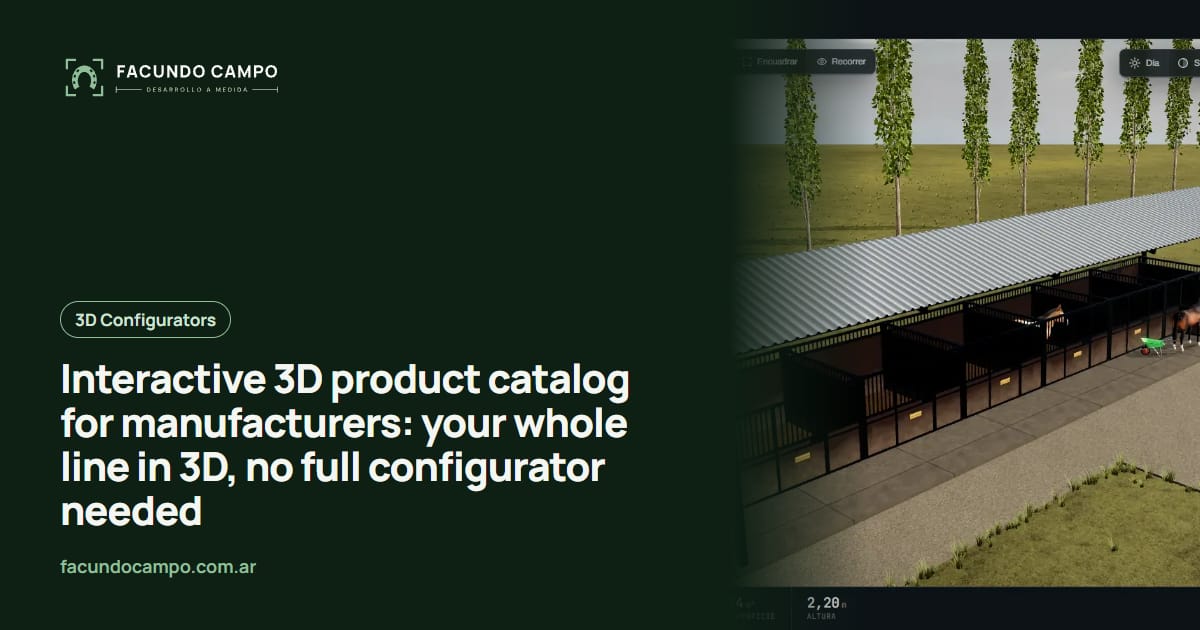
An interactive 3D catalog shows every product in your line in 3D, with its dimensions and variants, so the buyer can spin it, zoom in and understand it before messaging you. Not every product has to be configurable. It just has to be shown for real, from every angle.
This is for manufacturers with broad product lines, where building a full configurator for every model makes no sense. Think water tanks and livestock troughs, playground equipment, outdoor furniture, trailers, store fixtures: products with fixed sizes and versions that buyers still need to see clearly before they order.
Where the PDF catalog falls short
For years the PDF was how manufacturers showed their line, and it still has a place. But buyers hit its limits fast. Photos show one angle, usually the most flattering one. Dimensions sit in a separate table you have to match up with the picture. On a phone you pinch and scroll sideways to read anything. And every time something changes, the file gets redone and resent while old versions keep floating around in people's inboxes.
So the same questions keep coming in: “what does the back look like?”, “where's the drain?”, “will it fit through a standard door?”. Questions buyers could answer themselves if they could actually look at the product. I wrote the full comparison in 3D configurator vs PDF catalog.
What buyers see in a 3D catalog
They land on the product line page, see everything you make, and tap the one they're interested in. They can spin it with a finger, zoom into a detail, look at it from underneath or from behind. Dimensions are right next to it, and can show up on the model itself as measurement lines.
If the product comes in several versions (small, medium and large; with or without a lid; two colors), they switch with a tap and the model updates. They aren't designing something new. They're picking between versions you already build.
When they're ready, they ask for a quote on WhatsApp or by email with the product and version already in the message. You get “I want the tank in this size, with a lid” instead of “what tanks do you have?”.
3D catalog, configurator, or both
| Your situation | What makes sense |
|---|---|
| Lots of products with fixed sizes | A 3D catalog for the whole line |
| One best seller that's built to order | A configurator for that one, a catalog for the rest |
| A few products, all made to order | A full configurator |
| Simple products with no variants or hidden parts | Good photos and a clear spec sheet may be enough |
I mean that last row. If a good photo already answers every question, 3D doesn't add much. It pays off when buyers ask about what they can't see.
What the manufacturer gets out of it
Fewer repeat questions. What you used to answer over and over by message gets answered on screen.
A catalog that's always current. Change a dimension or drop a product and everyone sees the update. No outdated versions circulating.
Better material for your sales reps. The same catalog works on the road or in a meeting, open on a phone or tablet. I cover that in sales catalog apps for reps.
Pages Google can read. Every product gets its own page with a name, description and dimensions, which helps people find you when they search for exactly what you make. More on that in SEO for manufacturers.
A path to a configurator. If one product starts getting lots of custom requests, the 3D model already exists. Making it configurable is the next step, not a fresh start.
Where the idea comes from
In Estructuras 3D, the demo I built for manufacturers, metal buildings, carports, industrial buildings, horse stalls and modular homes all live in one place. It's a full product line on display, each item in 3D, which is exactly the foundation of a catalog. A 3D catalog takes that idea and simplifies it: the whole line is shown for real, and full configuration stays only where it earns its keep.
At EQUIBOX, a horse stall and barn manufacturer near Buenos Aires, Argentina, the 3D quote tool lets buyers design the barn with size, model, walls and accessories, download a PDF spec sheet and ask for a quote on WhatsApp. That's the best-seller case that does deserve a configurator.
See the Equibox caseHow it comes together
We start with your product list and versions, plus photos from several sides and dimensions. You don't need 3D drawings. Together we pick what goes first, usually the products that bring the most inquiries or the most confusion. I build each product in 3D along with the catalog pages, and you review every update from a link on your phone.
I work remotely from Buenos Aires, Argentina (UTC−3), with video calls and contact by WhatsApp or email. If you want examples from similar industries, the Estructuras 3D blog has a piece on what your customers configure that helps decide what to make adjustable and what to keep fixed.
Frequently asked questions
What's the difference between a 3D catalog and a 3D configurator?
In a catalog, buyers look at products that already exist: they spin them, check dimensions and switch between versions you defined. In a configurator, they design their own, with sizes and combinations of their choosing. Many manufacturers need a catalog for most of the line and a configurator for just one or two products.
Do my products need to be modeled in 3D already?
No. If you have drawings or design files, they help, but photos from several sides plus dimensions are enough. I build each product in 3D from that.
Can I add new products later?
Yes. You can edit each product's details (name, description, dimensions, versions) from a panel. When you launch a new product, I add its 3D model.
Does it help me show up on Google?
It helps, because each product gets its own page with a name, dimensions and description that Google can read. A PDF catalog usually stays buried inside a file.
If your product line lives in a PDF today and you'd like to show it in 3D, message me on WhatsApp at +54 9 11 6193-3176 or email contacto@facundocampo.com.ar. Tell me what you make and how many models you have. I answer in English and Spanish. More on [services](/en/servicios).