Online art catalog: how to show which works are available
When you sell one-of-a-kind pieces, your catalog has to say what's still available. How to show the status of each artwork, how to organize the catalog and what to do with sold works.
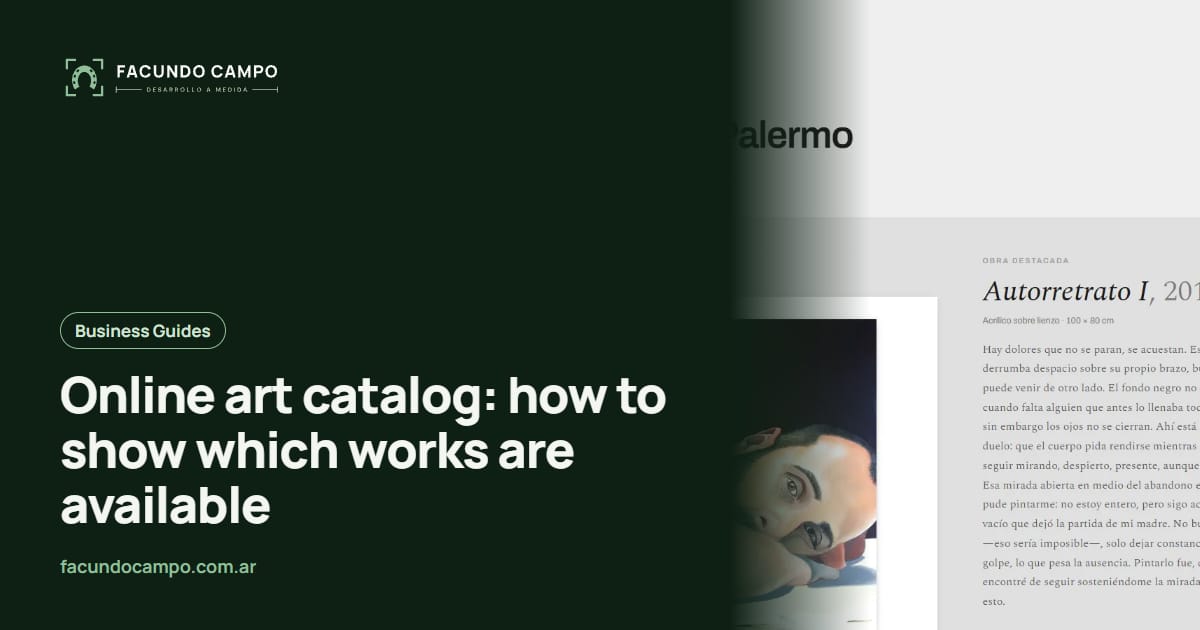
An online art catalog is the section of a website that holds an artist's entire body of work, each piece with its image, its details and its status: available, sold, reserved or on exhibition. What sets it apart from a regular product catalog is precisely that status: since each work is unique, the buyer needs to know at a glance which ones they can acquire.
Here's how to handle it, using the catalog I built for painter Pérez Palermo as an example: 31 works filterable by period, each with its status always visible.
Why should each artwork show its status?
In a store, when a product sells out, another identical one comes in. Not in art: when a painting sells, it's gone. If your catalog doesn't say so, two things happen. First, you get inquiries about works you no longer have, and each one ends in a 'that one's already sold' that disappoints whoever asked. Second, people browsing your site don't know what they can buy and have to write to you to find out, which many people simply won't do.
A visible status on each work solves both. Visitors see what's available and ask about that.
Which statuses should you use?
These are the four statuses in Pérez Palermo's catalog, and what each one tells the buyer:
| Status | What it means | What the buyer does |
|---|---|---|
| Available | The work is for sale. | Gets in touch or asks for the price. |
| Sold | It already has an owner. | Sees it as part of your body of work and looks for another available one. |
| Reserved | Someone has set it aside. | Knows it's not available for now, and can ask if it frees up. |
| On exhibition | It's hanging in a show. | Can go see it in person or ask about it. |
On the website, the status is shown with a colored dot under each work: green for available, red for sold and ochre for reserved.
Should sold works stay visible?
Yes, in most cases. A sold work is still your work: it shows your path, your technique and that your work has buyers. Taking it out of the catalog makes your story smaller. What matters is that it's clearly marked as sold, so it doesn't generate inquiries.
On Pérez Palermo's site, sold works stay in the catalog with their status dot. At the time of writing, the site shows 31 works, 18 of them available: the rest are sold, reserved or on exhibition, and the buyer can see that without asking.
How should you organize an art catalog?
With only a few works, a grid is enough. Once you pass twenty or thirty, it's worth adding a filter so the buyer goes straight to what interests them. The most common ways to group work are by period, by series or by medium.
Pérez Palermo's catalog is filtered by period, because his work has very distinct stages: Hyperrealist (9 works), Figurative (6), Abstract (8) and Exhibitions (8). Someone looking for his hyperrealist work doesn't have to scroll through the abstract pieces to find it. It's the same logic as an exhibition organized by rooms.
What details should each work in the catalog have?
In the grid, the image, the title and the status are enough. The rest goes on each artwork's page, which on Pérez Palermo's site is a page of its own:
- Medium and support: oil, acrylic, canvas, paper.
- Size: so the buyer can picture the work on their wall.
- Production date.
- A text by the artist about that piece.
- Price or 'price on request', decided work by work.
- Status, the same one shown in the grid.
Visible price or 'price on request'?
You don't need one rule for the whole catalog. Some works make sense to show with a price, so interested people feel encouraged to write, and others you'd rather discuss. On Pérez Palermo's website, each artwork page shows either the price or 'price on request', depending on the work.
What does matter is consistency: if a work says 'price on request', contact should be one tap away, via WhatsApp, not hidden at the bottom of a long page.
Pérez Palermo's catalog
Julián Andrés Pérez Palermo is a painter from Mercedes, in Buenos Aires province, Argentina, with original work on canvas and paper. Each piece is unique and comes with a signed certificate of authenticity. I built him a catalog website with his work filterable by period, the status of each piece always visible and a page for each artwork, like a museum wall label.
I don't change the status: he does. When a painting sells or goes out to an exhibition, he logs into the panel and marks it as sold, reserved or on exhibition. He also adds new works and edits and deletes existing ones.
See Pérez Palermo's catalogCatalog or online store?
An online store is designed to sell many units of the same product, with a cart, inventory and card payments. An art catalog is designed to show one-of-a-kind pieces and generate an inquiry. For many artists, the catalog is the right fit: selling an artwork usually goes through a conversation. If you sell editions, like prints or reproductions, that's where a store can make sense. The numbers for each option are in how much an online store costs.
Does it work for other industries besides art?
The 'catalog with status' idea works for anyone who sells unique units:
- Used cars: available, deposit paid, sold.
- Real estate agencies: each property is unique, and the status avoids inquiries about ones already rented or sold. More ideas in apps for real estate agencies.
- Custom furniture or design pieces: what's in the showroom, what's made to order and what's already been delivered.
- Handmade crafts: pieces that aren't repeated.
Where to go from here?
If you don't have a website yet, in artist portfolio website I go over which pages it needs. And if you want to update your catalog yourself, in a website you can update yourself I explain what can be edited and what can't.
Frequently asked questions
What is an online art catalog?
It's the section of an artist's or gallery's website where all the works live, each with its image, its details (medium, size, year) and its status: available, sold, reserved or on exhibition. It lets a buyer see at a glance what they can acquire.
Should sold works be removed from the catalog?
Generally, no. A sold work still shows your work and your career. What matters is that its status is clear, so nobody asks about it thinking it's available.
What's the difference between 'reserved' and 'on exhibition'?
Reserved means someone has already set it aside and, in principle, it isn't for sale. On exhibition means the work is hanging in a show: it may be available, but you can't deliver it right now.
Who updates the status of each artwork?
Ideally you do, from an admin panel. On Pérez Palermo's website, the artist marks each piece as available, sold, reserved or on exhibition without depending on a developer.
If you sell one-of-a-kind pieces, whether art, crafts, cars or furniture, your website has to say what's available. Tell me what you sell and how many pieces you handle, and I'll tell you how I'd build your catalog.