How to sell art online: getting collectors to find you
Selling art online isn't about a shopping cart: it's about being found, letting buyers see what's available and making it easy to contact you. What your website needs for that.
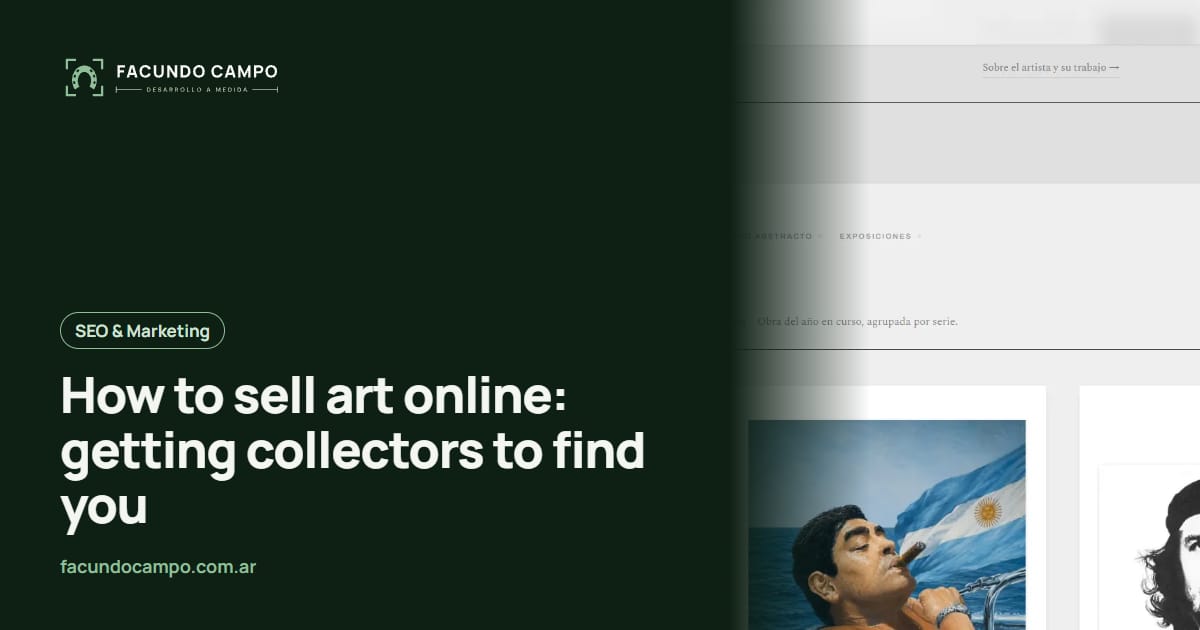
Selling art online, when it's one-of-a-kind pieces, isn't about adding a shopping cart: it comes down to three things. Collectors and galleries finding you when they search, seeing your work organized and knowing what's available when they land, and being able to contact you with one tap. A well-built website of your own covers all three; social media mostly covers the first.
I'll explain what your website needs for each, with what I applied on painter Pérez Palermo's website. I won't promise you sales: that depends on your work. What the website can do is not be the obstacle.
Where does a collector or gallery look for you?
Before writing to you, someone interested in your work searches for you. It might be by your name, after seeing a piece at an exhibition or in someone's home. It might be by a style or a medium combined with a place: 'Argentine hyperrealist painter', 'visual artist from Mercedes'. And more and more, they ask an AI assistant, which builds its answer from what it finds published.
In every case, what shows up comes from what's on the internet under your name. If all there is is a social media profile, that's what they'll see. If there's a website with your work organized and well described, you have much more control over what they find.
Is Instagram enough to sell art?
Instagram is great for getting your work around and showing your process, and there's no reason to drop it. But it has limits for selling one-of-a-kind pieces: posts are ordered by date, not by series; there's no clear way to mark which work has sold; and what you post depends on the platform's rules.
I made the full comparison in website or Instagram. For an artist, the practical takeaway is to use both: Instagram so people get to know you, and the website as the place where your complete body of work lives, with the link in your bio.
Why give each artwork its own page?
This is the decision that matters most for Google to find you. If all your work sits on a single page like a photo gallery, to Google it's one page with lots of images and little text. If each work has its own page, each one is one more chance to show up.
On Pérez Palermo's website, each work has its own URL (something like /obra/artwork-name), included in the sitemap, which is the list that tells Google which pages exist. And each artwork page has real text: medium, size, production date and a text by the artist about the piece. That text is what lets a search engine understand what the work is about, something a photo alone can't tell it.
What does your website need to show up on Google?
A concrete checklist for an artist's website:
- Your name in the site title. It's the first thing someone who met you at an exhibition will search for.
- One page per artwork, with its title, medium, size and year.
- Your own text on each artwork page. A few lines about the work are worth more than any generic description.
- Image descriptions. Photos carry alt text with the title and medium, which Google reads.
- An About section with your city, your training and your career.
- A sitemap, so Google finds every artwork page.
- Fast loading on mobile. With large images it's easy to make the site slow, and that works against you.
How long does it take to show up?
Showing up on Google isn't instant. Searches for your name usually respond first, because almost nobody else competes for them. Generic searches, like a style or a medium, take longer and more content. The good news is that it builds up: every new work you upload is one more page. I covered the general steps in how to rank first on Google.
Shopping cart or inquiry?
Once they find you, the question is how they buy from you. The two options, compared:
| Catalog with inquiry | Store with cart | |
|---|---|---|
| How the person buys | Sees the work, gets in touch via WhatsApp or email and closes the deal with you. | Pays online and you arrange shipping. |
| What kind of work it suits | One-of-a-kind work: paintings, sculptures, original pieces. | Editions: prints, reproductions. |
| Price | Visible or 'price on request', work by work. | Always visible. |
| What drives the cost | Number of works, texts and photos, and whether you upload the catalog yourself. | Everything in the catalog plus online payments, shipping and stock per edition. |
I quote per project: tell me what you need and I'll send you a fixed quote. What drives the cost is explained in how much a website costs.
What happens when the buyer reaches your website?
This is where the inquiry is won or lost. The buyer has to see three things without looking for them: the work at a good size, whether it's available and how to reach you. On Pérez Palermo's site, each work shows its status with a colored dot (available, sold, reserved or on exhibition), the artwork page shows the price or 'price on request', and WhatsApp contact is in the contact section and in the footer of every page.
It also helps to state what builds trust for someone buying from a distance. In his case, the site makes clear that each piece is unique and comes with a signed certificate of authenticity. I go into how to build a catalog with statuses in online art catalog.
Pérez Palermo's website
Julián Andrés Pérez Palermo is a painter from Mercedes, in Buenos Aires province, Argentina. His website brings together his original works on canvas and paper, filterable by period (Hyperrealist, Figurative, Abstract and Exhibitions), each with its own page and its status always visible. It's designed mobile-first, and he maintains the catalog himself: when he paints something new, he uploads it; when he sells a work, he marks it as sold.
See the Pérez Palermo caseFrequently asked questions
Can you sell artwork online?
Yes, but with one-of-a-kind pieces the sale usually starts online and closes in a conversation. What the website does is get you found, let the buyer see the work with its details and status, and let them contact you with one tap.
How do I get a collector to find me on Google?
With your own website where your name is in the title, each work has its own page with text (medium, size, year and a text of yours) and the site is in the sitemap so Google can crawl it. It's work that builds up over time, not overnight.
Do I need a shopping cart to sell art?
For one-of-a-kind work, usually not. A catalog that shows the status of each piece, the price or 'price on request' and quick contact via WhatsApp is enough. A cart makes more sense for editions, like prints or reproductions.
Is Instagram enough to sell art?
Instagram is great for getting your work known, but your posts are ordered by date and don't say what's available. A website organizes your work and makes you findable when someone searches your name. Ideally, use both.
If you want your work to be findable on Google and visitors to know what's available, tell me what you do and where you show it today. I'll tell you what makes sense to build.