Artist portfolio website: what a painter's site needs
Which pages a painter's or visual artist's website needs, what details each artwork should carry and how to present it with gallery-level care. With the real case of Pérez Palermo.
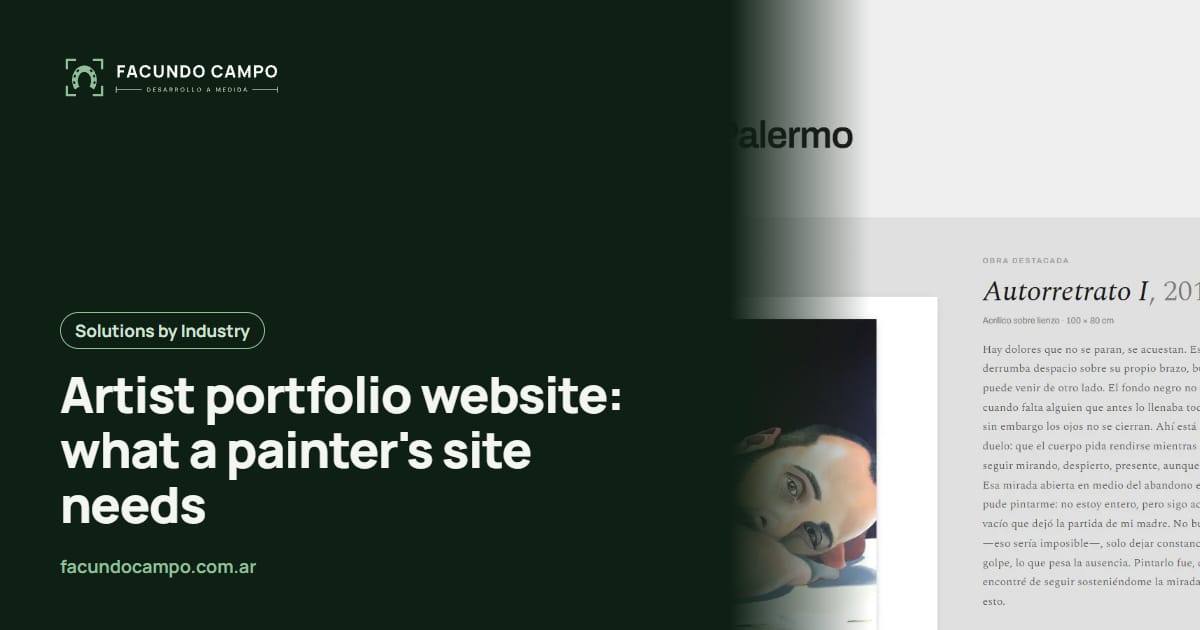
A website for a visual artist has three jobs: show the work with the care of a gallery, say clearly which pieces are still available, and make it easy for a buyer or a gallery to contact you. To do that it needs a catalog organized by series or period, a page for each artwork with its details, and a simple way to get in touch. Everything else is secondary.
In this post I cover which pages are worth having, what details each artwork should carry and what it costs, using as an example the website I built for painter Pérez Palermo.
Why does a painter or visual artist need a website?
An artist sells one-of-a-kind pieces. When a painting sells, it's gone, and there's no identical one in storage. That changes everything compared to a regular store: the buyer doesn't just want to see the work, they want to know whether they can have it.
Your own website gives you one place where all your work lives together, organized the way you want and with the details a collector needs to decide. It's the link you send when a gallery asks to see your work, the one on your business card and the one that shows up when someone googles your name. If today you only show your work on social media, I compared what each option gives you in website or Instagram.
What pages should an artist's website have?
You don't need a huge site. These are the sections that actually get used:
- Home page with a featured artwork. One large piece, with a short text introducing it, and a direct link to the rest of the work.
- Artwork catalog. All the pieces together, with filters by series, period or medium so it isn't an endless wall of images.
- A page for each artwork. Its own page for every piece, with medium, size, year and a text about the work.
- Status of each piece. Available, sold, reserved or on exhibition, visible both in the catalog and on the artwork page.
- About. Who you are, where you're from, how you work. An art buyer also buys the story of the person who paints.
- Contact. WhatsApp and email within reach, no long forms.
What does Pérez Palermo's website look like?
Julián Andrés Pérez Palermo is a painter from Mercedes, a town in Buenos Aires province, Argentina. His website brings together original work on canvas and paper, with both available and sold pieces on view. Each piece is unique and comes with a signed certificate of authenticity.
The home page opens with a featured artwork, accompanied by a curatorial text and a carousel with more works. The catalog can be filtered by period: Hyperrealist, Figurative, Abstract and Exhibitions. Each artwork shows its status with a colored dot and has its own page with medium, size, production date, the artist's text and either the price or 'price on request'. And the most important part day to day: the artist manages his catalog on his own, adding, editing and deleting works without depending on anyone.
See the Pérez Palermo caseWhat details should each artwork page include?
The artwork page does the job of the wall label at an exhibition. These are the details worth including and what each one is for:
| Detail | What it is for |
|---|---|
| Title | Identifies the work when someone asks you about it. |
| Medium and support | Oil, acrylic, canvas, paper: it's one of the first things a buyer asks. |
| Size | Lets them picture the work on their wall before writing to you. |
| Year | Places the piece within your career. |
| Artist's text | Tells what the photo can't. It also gives Google words to understand the page. |
| Status | Avoids inquiries about works that are no longer there. |
| Price or 'price on request' | You decide piece by piece. |
How do you show art without it looking like a store?
This is the most common mistake on artist websites: using an online store template, with 'add to cart' buttons and sale banners. The work ends up shrunk between elements competing with it.
With Pérez Palermo the idea was the opposite: a gallery, not a store. Gray walls, each work framed in a white mat, titles in italic serif like an exhibition wall label, and plenty of white space. The only strong colors are the paintings and the small status dot under each one: green for available, red for sold, ochre for reserved.
I explained why a custom build beats a generic template in custom website vs template. On an art site the difference shows even more, because the design has to serve the work.
Does it need to look good on a phone?
Yes, and that's probably where most people will see it. Someone who discovers you at an exhibition or gets a link over WhatsApp, the main messaging app in Argentina, opens your site on their phone. Pérez Palermo's website is designed mobile-first: you swipe through the catalog with your thumb, the period filter stays within reach and the artwork page keeps the image large with the details below.
How much does a website for a visual artist cost?
It depends on three things: how many pages the site has, whether you want your own panel to manage the catalog with your rules (status, periods, price shown or on request) and whether you'll also take payments online with a shopping cart. How many works need to be loaded at the start and who writes the texts also matter. Tell me what you have and I'll send you a fixed quote within 48 hours, over WhatsApp or email.
The breakdown for each type of website is in how much a website costs in Argentina, and what you'll pay afterwards to keep it online, in how much it costs to maintain a website.
What should you prepare before starting?
- Good photos of each artwork. Straight on, with even lighting and unframed if possible. This weighs more than anything else on the result.
- A spreadsheet of your work. Title, medium, size, year and status of each piece.
- How you want to group it. By period, by series or by medium.
- Your texts. A short bio and, if you can, a few lines about each work.
- What to do about prices. Show them, hide them or decide work by work.
And afterwards, who maintains it?
Your body of work changes: you paint new pieces, sell others, some go out to an exhibition. If every change depends on messaging the developer, the site goes out of date fast. That's why it's worth being able to manage the catalog yourself. I explain how that works in a website you can update yourself, and how to get collectors to find you in how to sell art online.
Frequently asked questions
What should a visual artist's website include?
The basics: a home page with a featured artwork, the catalog of your work organized by series or period, a page for each piece (medium, size, year and a short text), the status of each work (available, sold, reserved), an About section and a simple way to get in touch, such as WhatsApp.
Should I show prices for my artworks?
It depends on the artist and on each piece. You can decide work by work: some with the price on display and others marked 'price on request'. That's how painter Pérez Palermo's website handles it: each artwork page shows one or the other depending on the piece.
Can I add new artworks myself?
Yes, if the site is built with an admin panel. In Pérez Palermo's case, the artist adds new works, edits and deletes existing ones and changes the status of each piece without depending on a developer.
How much does a website for an artist cost?
It depends on how many pages it has, whether you want a panel to add the work yourself and whether you'll sell online with a shopping cart. Message me on WhatsApp or email with what you need and I'll send you a fixed quote within 48 hours.
If you paint, sculpt or make one-of-a-kind work and want a website that presents it properly, tell me what you do and how many pieces you have. I'll tell you what makes sense to build.