Custom furniture configurator: size, wood and finish settled before you quote
A custom furniture configurator lets buyers enter the size of their space, choose wood, finish and hardware and see the piece in 3D. The shop gets a clear order instead of a week of photos, sketches and “can it be a bit shorter?”.
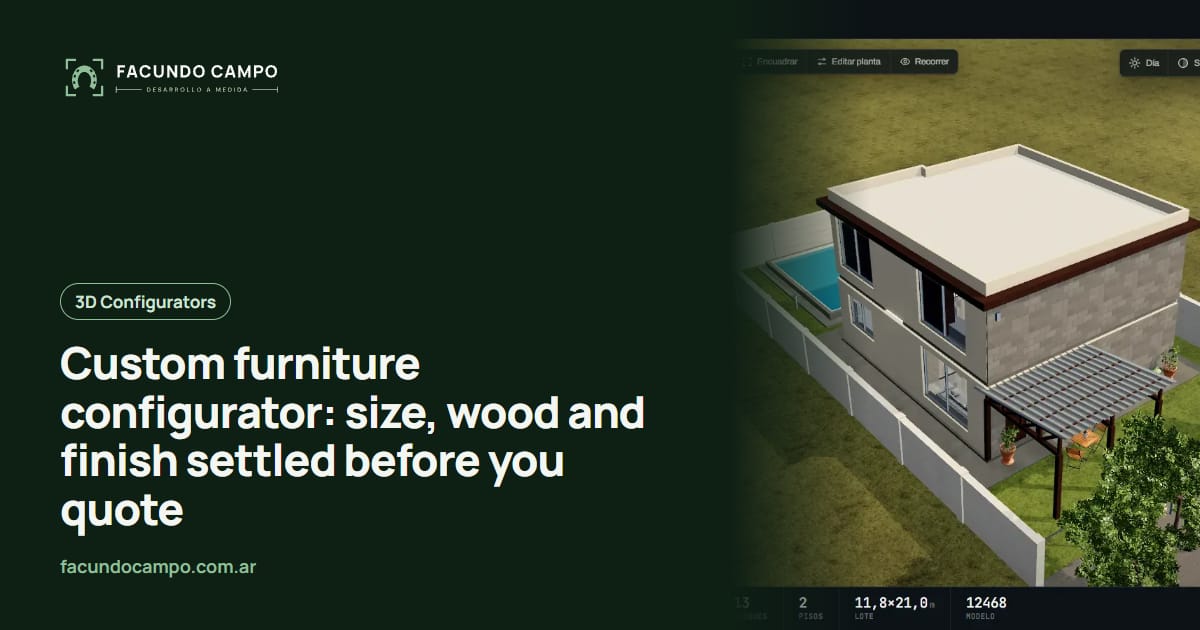
A custom furniture configurator is a tool on your website where buyers enter the size of their space, choose the wood, finish and hardware, and see the piece in 3D. When they reach out, the order is already clear, and you get to quote instead of decode.
This is for furniture makers and woodshops that spend half their week answering “can you build a bookcase for this wall?” with a photo attached.
The back-and-forth every maker knows
A buyer sends a photo of an empty wall with numbers written on it. Inches? Centimeters? Wall to wall or trim to trim? Then a screenshot of a dining table they liked, “but a bit shorter and in walnut.” You sketch something, they ask if the legs could be different, then whether it would look better in white oak. A week goes by and you still don't have an order.
The buyer isn't the problem. They just don't have a way to show you what's in their head. A configurator gives them one. They type in the width and height, pick the number of shelves, try doors on the bottom, flip between two finishes and see it. Then they send you something you both read the same way.
Pieces that work well in a configurator
Anything you build over and over with variations:
- Dining tables: length, width, top style, wood species and legs.
- Bookcases and shelving: sections, shelf count, cabinet doors below or not.
- Media consoles: length to fit the wall, drawers or doors, room for equipment.
- Desks: size, drawers on one side or both, cable management.
- Beds and headboards: mattress size, height, storage drawers underneath.
What goes on screen and what stays with you
| In the configurator | Better handled by you |
|---|---|
| Width, height and depth within your ranges | Final measuring for a built-in |
| Wood species, stain and paint colors | Physical samples when the exact tone matters |
| Shelves, doors and drawers | One-off artistic details |
| Leg style, pulls and hardware | Lighting, outlets and out-of-square walls |
Fewer mistakes on the shop floor
In custom work, every misunderstanding costs you lumber or a piece that doesn't fit through the door. When the order comes in with size, wood, finish, hardware and a picture of the piece, your shop builds from something concrete. And if the buyer later says “I thought it had doors,” the spec sheet they built settles it without an argument.
If you also want to keep track of jobs in progress, materials and deadlines, that's a separate step. I wrote about it in software for furniture makers. Kitchens and closets have their own module logic, so they got their own piece: kitchen and closet configurator.
Same idea, different product
For EQUIBOX, a horse stall and barn manufacturer near Buenos Aires, Argentina, I built a 3D quote tool where customers design their own barn by picking size, model, walls and accessories, download a PDF spec sheet and ask for a quote on WhatsApp. Different product, same problem a furniture shop has: customers who couldn't explain what they wanted.
To get a feel for how a configurator responds when you change sizes and finishes, try Estructuras 3D, my demo for building manufacturers.
See the EQUIBOX caseIf you sell mostly on Instagram or online marketplaces
Plenty of makers get most of their attention on Instagram or marketplaces, and that's fine: that's where people browse. The configurator doesn't replace that, it finishes the job. Put the link in your bio and in your posts, and the person who loves a table builds their own version on your site instead of commenting “price?”. If you sell online already, a 3D product viewer for online stores is a lighter option worth knowing about.
I work on my own, remotely from Buenos Aires, Argentina (UTC−3), with video calls and progress you can open from a link. To start, I need photos of your pieces, the size ranges you build and the materials you use.
Frequently asked questions
Which furniture works best in a configurator?
Pieces you build repeatedly with variations: dining tables, bookcases, media consoles, desks, shelving, headboards and beds. The clearer the rules (this piece goes from this size to that size, in these woods), the better it works.
Does it replace measuring at the customer's home?
No, and it shouldn't. It helps the buyer decide what they want and tells you what to quote. For built-ins that go wall to wall, your shop still takes the final measurements.
Can I show prices as the buyer changes options?
You can, if your pricing follows clear rules by size and material. Many makers prefer to show nothing and quote by hand. The configurator works either way.
If you run a furniture shop and want orders to arrive clear and complete, message me on WhatsApp at +54 9 11 6193-3176 or email contacto@facundocampo.com.ar. I answer in English and Spanish and quote each project on its own. More on [services](/en/servicios).