From spreadsheets to one system: how a Buenos Aires pet store connected its clinic, store and website
Mecohue is a pet store and vet clinic in Wilde, Buenos Aires. Its clinic ran on paper, its register had no stock control and it had no website. Here is how we built a single system for all three parts of the business and what we learned along the way.
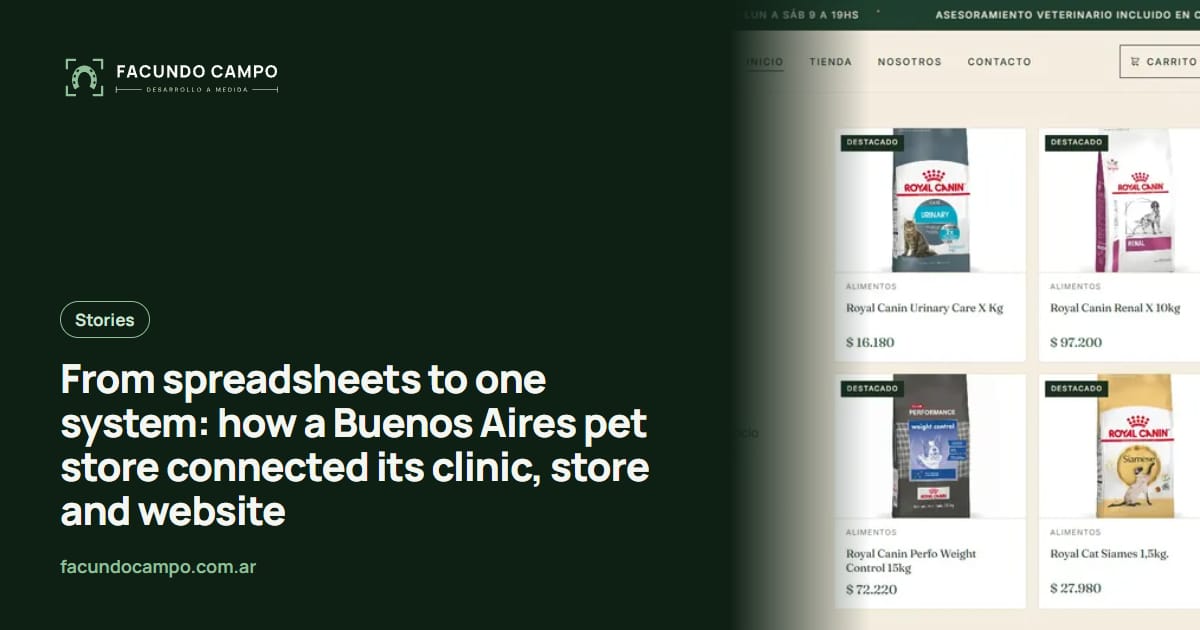
Moving from spreadsheets to a management system isn't swapping Excel for a program: it's getting everything that happens in the business recorded in one place, connected. This is the story of Mecohue, a pet store with a veterinary clinic in Wilde, Buenos Aires, that worked with paper and spreadsheets and today has its clinic, grooming service, store register and website in a single platform.
I'm Facundo Campo, the developer of that system: I built it end to end. Here's where we started, the decisions we made and what changed.
How did the business run before the system?
Mecohue is a pet store with a vet clinic and grooming in Wilde, a suburb of Buenos Aires. Like many small businesses with years in the neighborhood, it grew with whatever tools were at hand, and at some point it ran into three problems at once.
The clinic, on paper. Clinic management wasn't digitized.
The register, with no control. Daily sales had no stock control and no record of what was sold to whom.
No online channel. Customers had nowhere to see products or book an appointment: there was only social media.
None of the three is unusual. What was particular is that all three lived in the same business with the same customers: the owner who brings their dog in for a vaccine is the same person who buys the food.
Why one system instead of three tools?
The obvious option was to solve each problem separately: software for the clinic, a register system and a shop on a platform. It works, but it leaves the job of joining everything to someone: customers get entered twice, products live in two places, and to know how the business did in the month you have to gather numbers from three systems.
That's why I proposed a custom platform covering the three legs of the business in a single system: the public site, the clinic management and the shop with its point of sale. The goal was simple to state: every sale linked to a customer, every vaccine to a pet, and the whole business visible in a single report.
What ended up in each part of the system?
| Part | What it includes | Who uses it |
|---|---|---|
| Public site | Catalog with search and filters by species and category; each product with its sizes and a button to check availability over WhatsApp; clinic and grooming services booked over WhatsApp; home delivery in Wilde and nearby; a WhatsApp button always on screen. | Customers. |
| Clinic management | A “Today” screen with every visit (arriving, waiting, being seen, ready to pay and done, including walk-ins and emergencies); each pet's record with medical history, vaccines, deworming and grooming; PDF prescriptions and certificates; vaccination certificate sent over WhatsApp; one-tap reminders for vaccines, deworming and baths. | The clinic and grooming team. |
| Shop and point of sale | Visit and purchases rung up together, with cash, card, Mercado Pago and store credit (customer account) in the same sale; stock that updates itself; the day's register with its closing; monthly reports for clinic, grooming and shop. | Whoever runs the register. |
What was hardest to bring together?
Merging three systems into one has a cost: each part has different users, different screens and different rules, and it still has to feel like a single tool. Three things took more work than the rest.
Keeping the parts from getting mixed up. The public site, the clinic management and the shop are part of the same system. Each part was built so that a change in one doesn't break another, and each person sees only what matches their job.
Making sure the register never leaves anything half-done. A sale can combine the visit and the purchases, and be paid with cash, card, Mercado Pago and customer account at the same time, and when it's confirmed, the stock is deducted, the payments are recorded and the customer's account is updated in a single operation. If something fails, nothing is saved. I explain it in detail in POS system with inventory control.
Making the report show the whole business. Point-of-sale sales were added to the report that already covered the clinic and grooming, separating what was billed from what was collected. How to think about that report is in sales reports for your business.
What did we learn after launching it?
The biggest lesson came after the first rollout at Mecohue: the system was used a lot from a phone. The management side was designed for a computer, and on a phone the long tables and filters became awkward.
So we did a second design pass just for that: fixed columns in tables so you don't lose sight of the key data when scrolling, a floating menu button, the background locked while the menu is open and a filter bar that stacks without breaking. Today the panel is used from a phone and installs like an app.
The lesson applies to any small business: it's not enough to ask how the system will be used; you have to watch how it's actually used and adjust.
See the Mecohue caseWhat changed day to day?
The underlying change is going from paper and spreadsheets to having everything recorded and auditable in real time. Specifically: every sale is linked to a customer, with the details of how they paid; every vaccine is linked to a pet, with its PDF card; customer tabs live in customer accounts with the balance up to date; customers browse products on the website and check availability or book over WhatsApp in one tap; and the whole business (clinic, grooming and shop) shows up in a report you can check from your phone.
I won't give you improvement percentages because we didn't measure it that way, and I'd rather not make them up. What I can say is that information that used to be scattered across paper, spreadsheets and the memory of whoever was at the counter is now in one place.
Who owns the system?
The business does. Each person logs in with their own user and sees what matches their job, the information is backed up automatically every day, vaccination cards and prescriptions come out as PDFs ready to send, and the website loads fast even with lots of product photos.
For a business owner, what matters is one thing: the system belongs to them and doesn't depend on a subscription to a third-party platform to keep working. What it costs to maintain is explained in how much it costs to maintain a website.
What would I tell a small business that wants to leave spreadsheets behind?
- Start with what hurts most. You don't have to digitize everything at once; a good system lets you add parts later.
- Think about connecting, not just digitizing. Moving each spreadsheet into a different program leaves you with the same problem in another format.
- Gather what you already use. Spreadsheets, record cards and receipt books are the best guide for making the system match how you work.
- Watch how it's used. If the system is used from a phone, it has to be designed for the phone.
- Protect the data. Automatic backups from day one.
Frequently asked questions
What's the advantage of a single system over several separate tools?
Data isn't entered twice and everything stays connected: each sale linked to a customer, each vaccine to a pet and the whole business in the same report. With separate tools, joining that information falls on someone, by hand.
Do you have to digitize everything at once?
No. A well-built system lets you start with one part and add modules later without redoing what came before. At Mecohue, for example, point-of-sale sales were added to a report that already covered the clinic and grooming.
How much does an integrated system for a small business cost?
It depends on how many parts it has to cover (clinic, register, online store, appointments), how many user types it has and whether you start with everything or one part at a time. Tell me about your business on WhatsApp or by email and within 48 hours I will send you a fixed quote.
What happens to the data if something breaks?
At Mecohue, the system makes automatic backups every day, so the information is safe even if a computer at the store fails.
If your business has its information scattered across paper, spreadsheets and several apps, tell me which areas you have and how you record everything today. I'll suggest which part I'd start with, how it would connect to the rest, and within 48 hours I'll send you a fixed quote. Write to me on WhatsApp or by email.