3D configurator for dealer networks: every dealer shows and quotes the same thing
A dealer network 3D configurator is one tool every point of sale uses, each with their own login. Every dealer shows the same models and the same rules, and orders reach the factory in one place instead of through a dozen different chats.
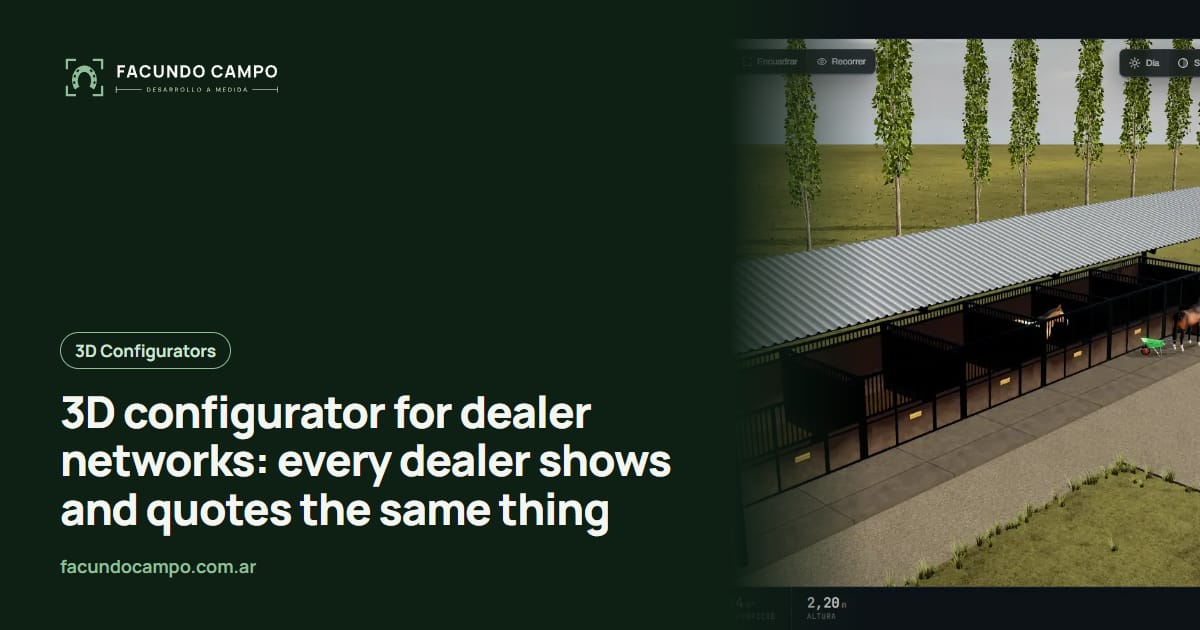
A dealer network 3D configurator is one tool that every point of sale for your factory uses, each with their own login. Every dealer shows the same models under the same rules, the buyer designs the product in 3D alongside the dealer, and the order lands at the factory in one place.
If you sell through dealers, distributors or retailers in other cities, you know the hard part isn't only selling. It's making sure what gets sold at each location matches what the factory can actually build.
What a dealer network looks like today
It plays out the same way at a lot of manufacturers who sell through others. Every dealer has a different version of the catalog: one has last year's PDF, another has loose photos you sent over WhatsApp, another built their own price sheet. When a customer asks for something, the dealer texts you to check whether it's possible, or worse, promises it and figures it out later.
Orders arrive as messages, voice notes and spreadsheets in a dozen formats. Someone at the factory retypes them, chases what's missing, and now and then finds out a dealer sold a combination you don't make. The factory doesn't know what's being quoted where until the order shows up, and the dealer doesn't know where their order stands until they call.
Nobody's doing anything wrong. It's just what happens when every location works with its own tools.
What a shared configurator changes
- One live catalog: when a model or finish changes, it changes for everyone at once. No old versions floating around.
- Factory rules everywhere: what you don't build can't be configured, no matter who's selling it.
- Buyers see what they're buying: the dealer builds the product at the counter or on a video call, and the customer watches it in 3D instead of imagining it.
- Orders in one format: every order comes in with the same sizes, options and references, ready for production.
- Visible status: dealers can check where each order stands without picking up the phone.
- Routed inquiries: leads that come through the factory website go to the dealer for that area, with the full configuration.
Different terms for different dealers
Dealer networks are rarely uniform. There are big distributors and small lots, dealers who carry the full line and others who carry two products. The configurator can reflect that: each dealer logs in and sees the products and terms the factory set for them.
You can also cap what each one is allowed to offer, so your margin doesn't depend on every dealer's goodwill. On the Estructuras 3D blog I wrote about controlling sales rep discounts and about running a 3D configurator for dealer networks, with examples from steel building manufacturers.
“My dealers won't use anything new”
That's a fair worry. A lot of dealers have worked the same way for years and don't have time to learn something else. If the new tool adds steps, they'll drop it within a week.
So the configurator has to be easier than what they do now, not just nicer looking. It should work on a phone, send an order in a couple of taps, and need no more training than a short call. Start small, too: two or three dealers you trust who try it with real customers, tell you what slows them down and help you win over the rest.
One argument that tends to land with dealers: they close faster, because customers decide when they can see the product, and they stop waiting on the factory to confirm whether something can be done.
At the counter, at the show and on the dealer's website
The same configurator works in different settings. At the dealer's location, on a tablet on the counter. At a county fair or trade show, where buyers design their product and walk away with a spec sheet; more on that in 3D configurator for trade shows. And on each dealer's website, with their contact details, so their inquiries come in ready to work.
If your network also orders parts or standard products that don't need configuring, a B2B customer portal can sit alongside the configurator. For reps who sell on the road, see sales catalog app for reps.
The foundation that already works: Equibox
For EQUIBOX, a horse stall and barn manufacturer near Buenos Aires, I built the 3D quote tool where customers design their barn (size, model, walls and accessories), download a PDF spec sheet and request a quote on WhatsApp. The company follows up on each lead with its sales team and CRM. Equibox sells through its own team, not dealers, but the foundation is the same: a configurator with the factory's rules and every inquiry in one place. Adding dealer logins is the next step on top of that.
See the Equibox projectHow we'd build it
I work on my own and remotely from Buenos Aires (UTC−3), with video calls and progress links you can forward to a dealer for feedback. We start with your products and rules, then with how your network is set up: who sells what, where, and on what terms. I quote each project based on its size; it usually makes sense to go in phases, configurator first and dealer logins after.
Frequently asked questions
Does each dealer see their own terms?
Yes. Each one logs in and sees what the factory set for them: which products they carry, what terms they have and what they can offer the customer. The end buyer only sees what's meant for them.
Can dealers put the configurator on their own website?
Yes. There can be a version each dealer embeds on their site or shares by link, with their own contact details. Inquiries that come in that way go to the dealer, and the factory sees them too.
What about inquiries that come through the factory's website?
They can be routed to the dealer covering the buyer's area, with the full configuration attached. The factory doesn't end up competing with its own network, and dealers get inquiries that are ready to work.
Will my dealers actually use it?
They will if it saves them work compared to what they do now. That's why it pays to start with two or three dealers you trust, listen to what slows them down, and only then roll it out to the rest.
If your company sells through dealers or distributors and you want all of them showing and quoting the same thing, message me on WhatsApp at +54 9 11 6193-3176 or email contacto@facundocampo.com.ar and tell me how your network is set up. I answer in English and Spanish. More on my [services page](/en/servicios).