Developer and horse rider: what riding has to do with building software for the equestrian world
I'm a developer and a lesson rider: I ride on weekends at a club. That doesn't make me a horse expert, but it gives me something useful when I build software for the equestrian world: I know the setting, the vocabulary and what matters to the people whose days revolve around horses.
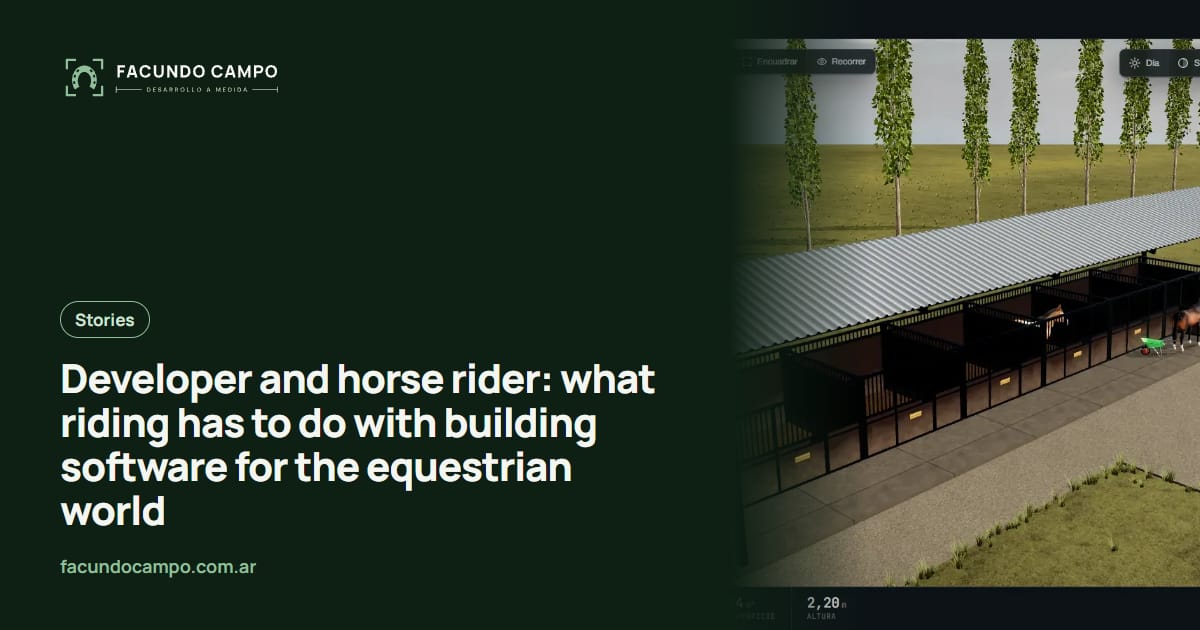
I'm a developer and a lesson rider. During the week I build websites, business software and 3D configurators; on weekends I ride at a club. They sound like unrelated worlds, but building the 3D configurator for EQUIBOX, a horse stall manufacturer, made it clear that one feeds the other.
I'm not a horse expert and I won't claim to be. But there are things you pick up by being there, in the arena and in the barn aisle, that you don't get from reading a project brief.
What you get from being on the other side
When I build software for an industry I don't know, the first part of the job is learning: how people talk, what worries them, what's obvious to them and not to me. In the horse world, a good chunk of that comes already done.
I know what a stall is, what a barn aisle is, what an indoor arena is. I know a horse owner doesn't settle for just anything, because they're thinking about the animal before the building. And I know that many people buying a stall or running a barn talk like barn people, not like a product catalog. That difference sounds small, but it changes how every button is worded and how every screen is laid out.
What lesson riding has in common with building software
These aren't stories. They're things anyone who rides in a lesson program will recognize, and I use them in my work every day.
- The basics get repeated until they're automatic. In lessons you work the same fundamentals over and over before moving on. In a project, same thing: get the essentials working well, then add the rest.
- Feedback is instant. A horse shows you right away when something's off. So does a client trying out a progress link. That's why I share progress often, not just at the end.
- Someone else knows more. In the arena, the instructor sees what you can't from the saddle. In a project, the client knows the business; I bring the tool.
- Patience beats rushing. Forcing things rarely goes well, whether you're on a horse or halfway through building software.
Where the two worlds met: EQUIBOX
EQUIBOX is a horse stall and barn manufacturer near Buenos Aires, Argentina. I built their 3D configurator, live at cotizador.equiboxarg.com: customers design their barn in 3D by choosing dimensions, model, walls and accessories, download a spec sheet or quote as a PDF and request pricing over WhatsApp. On the other end, the company has a CRM and sales reps who follow up on those requests.
That's where riding really pays off. For a buyer to design a barn alone, with no sales rep beside them, every option has to be worded the way they'd say it. I wrote about the design decisions behind it on the Estructuras 3D blog: EQUIBOX design decisions.
The EQUIBOX 3D configurator
Buyers design their barn in 3D, see it change with every choice and download a PDF spec sheet to think it over or share it. When they're ready, they request a quote over WhatsApp with everything already defined, and the company receives it in its CRM so a sales rep can follow up.
See the EQUIBOX caseWhat I build for the horse world now
The horse world is one of my favorite industries to work in. For stall and barn builders, there's the horse barn configurator. For equestrian centers, a website that shows what they offer and makes a first visit easy to book. For riding schools, riding school management software that handles lessons, horses and payments. And for breeding and boarding operations, horse farm management software.
The idea is the same in all of them: the tool speaks the language of the barn and saves time for people who'd rather be with their horses than with a spreadsheet.
And if your business has nothing to do with horses
That's completely fine. What this mix taught me applies anywhere: before building anything, understand how the people who'll use the tool talk and what they worry about. With a steakhouse, a pet store or an artist, I do the same thing, I just learn it from scratch. You can see what I build in services.
Frequently asked questions
Do you only build software for the equestrian industry?
No. I build websites, business software, apps and 3D configurators for all kinds of businesses: a steakhouse, a pet store with a vet clinic, a visual artist. The horse world is one where I also happen to know the setting from the inside.
Are you a horse expert?
No, and I don't claim to be. I'm a lesson rider who rides on weekends at a club. What that gives me is familiarity with the setting and the vocabulary, and knowing what to ask. The horse knowledge belongs to the client; my job is turning it into a tool.
What kind of equestrian projects do you take on?
3D configurators for horse stall and barn builders, like EQUIBOX's, plus websites for equestrian centers and software for riding schools and horse farms. Each one has its own article on the blog if you want the details.
If you run a stall or barn company, an equestrian center, a riding school or a horse farm, or any business that needs a tool built to fit it, message me on WhatsApp at +54 9 11 6193-3176 or email contacto@facundocampo.com.ar. I answer in English and Spanish.